PROF. RUGGERO MARIA SANTILLI
PRIZES AND NOMINATIONS
Prepared by the Board of Trustees of the T. M. Santilli Foundation
All pictures are authorized for free download.
For comments please contact
"board(at)santilli-foundation(dot)org"
Jamuary 6, 1982
GOLD MEDAL FROM THE UNIVERSITE' D'ORLEANS, FRANCE
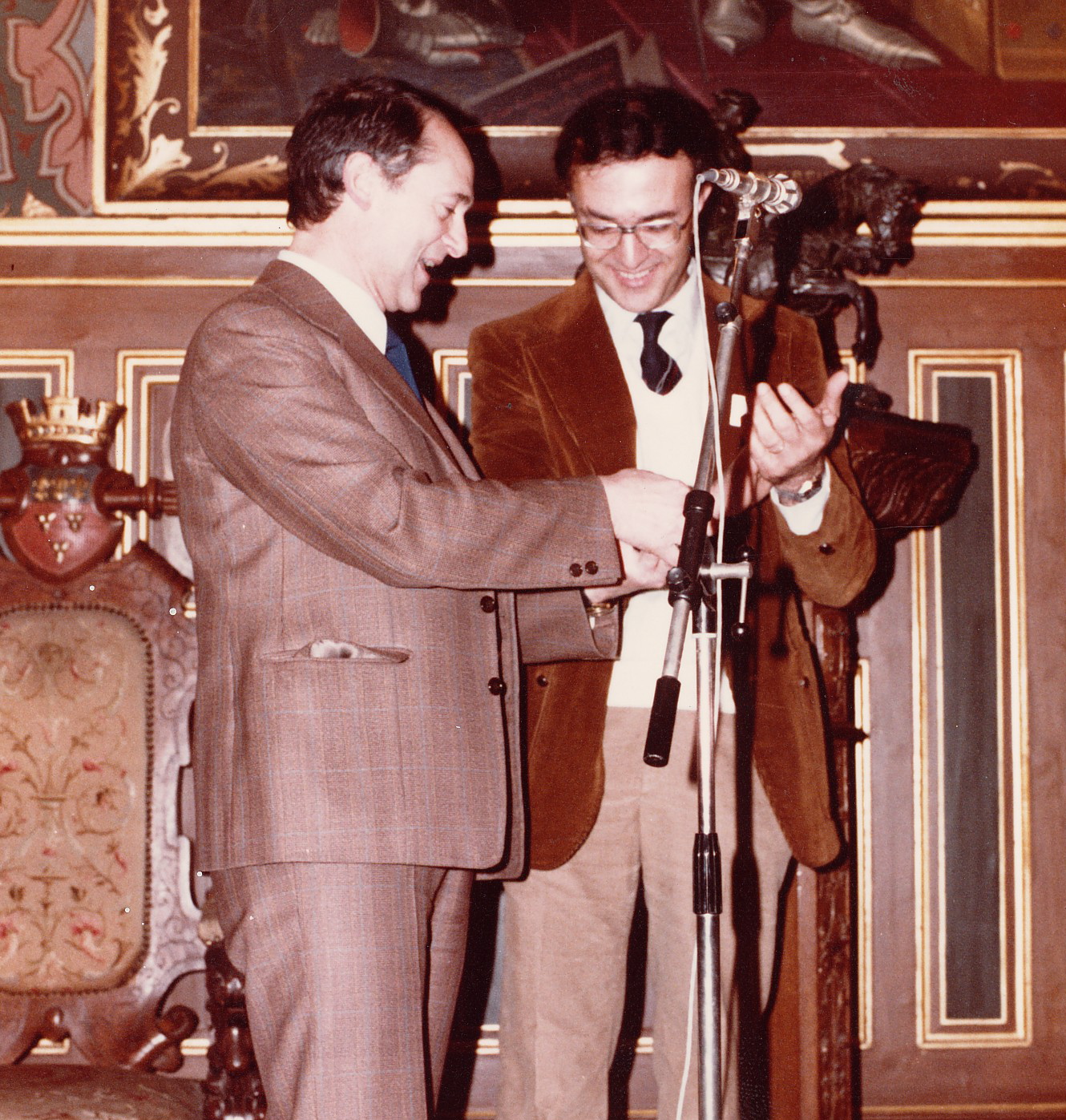
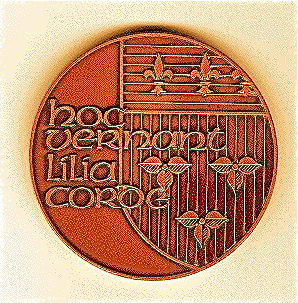
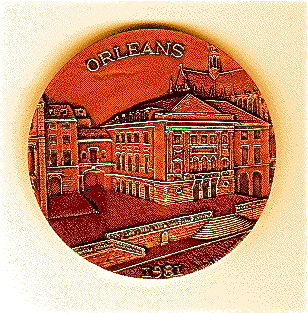
A view of the Gold Medal for Scientific Merits received by Prof. Santilli from the University of Orleans, France, on January 6, 1982, during the First International Conference on the Lie-Admissible Treatment of Non-Potential Interactions for his pioneering of the field. Prof. Santilli has also received other Gold Medals for Scientific Merits.
NOMINATION BY THE
ESTONIA ACADEMY OF SCIENCES among the
MOST ILLUSTRIOUS APPLIED MATHEMATICIANS OF ALL TIMES
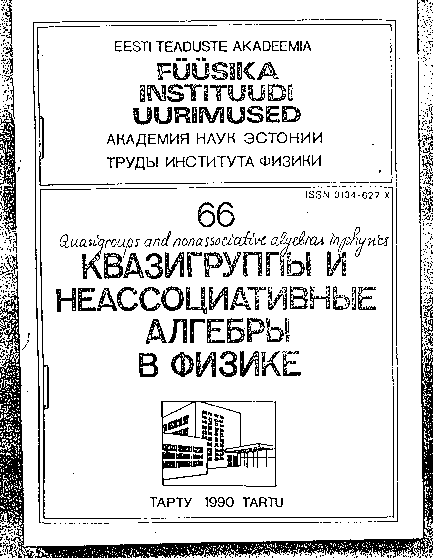
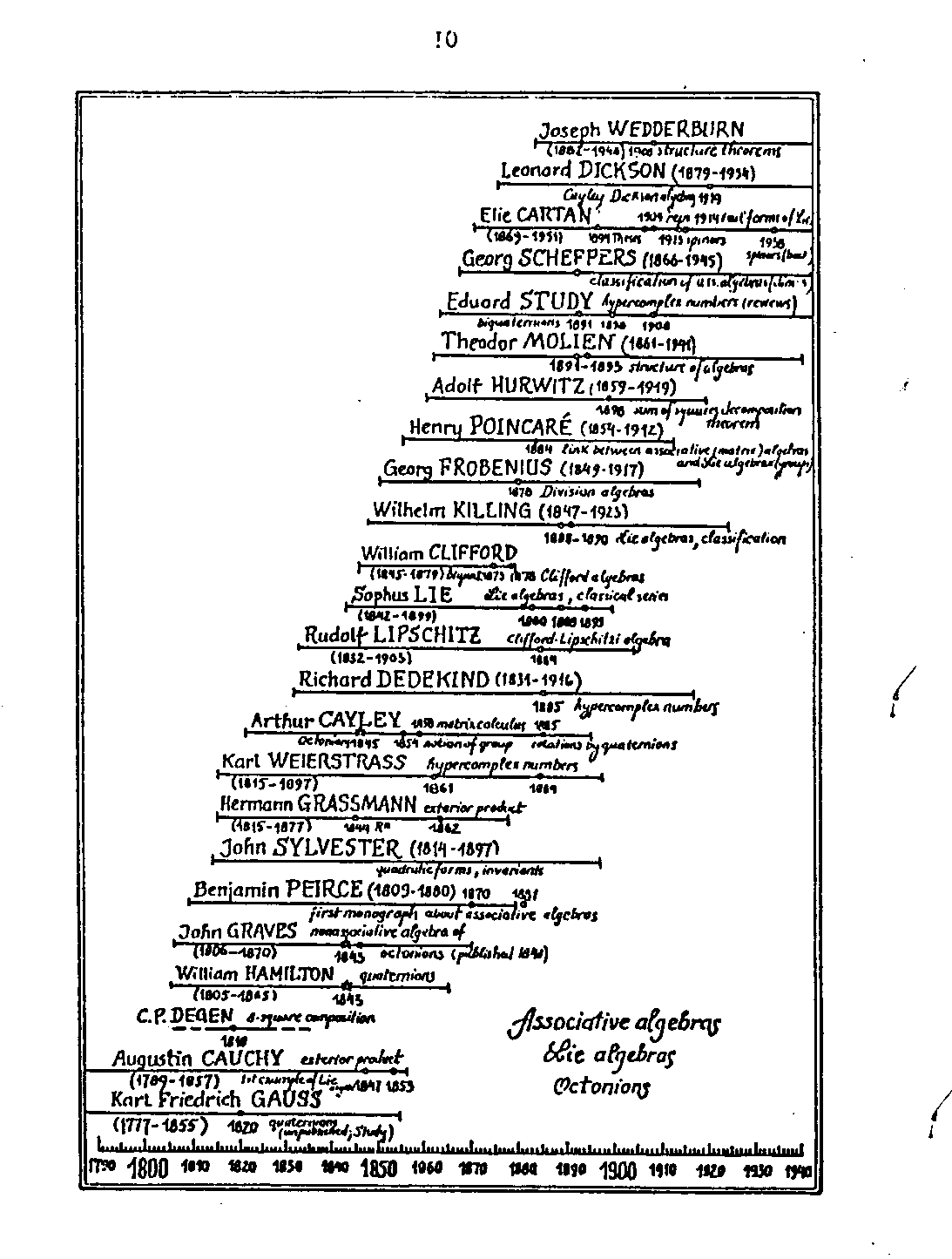
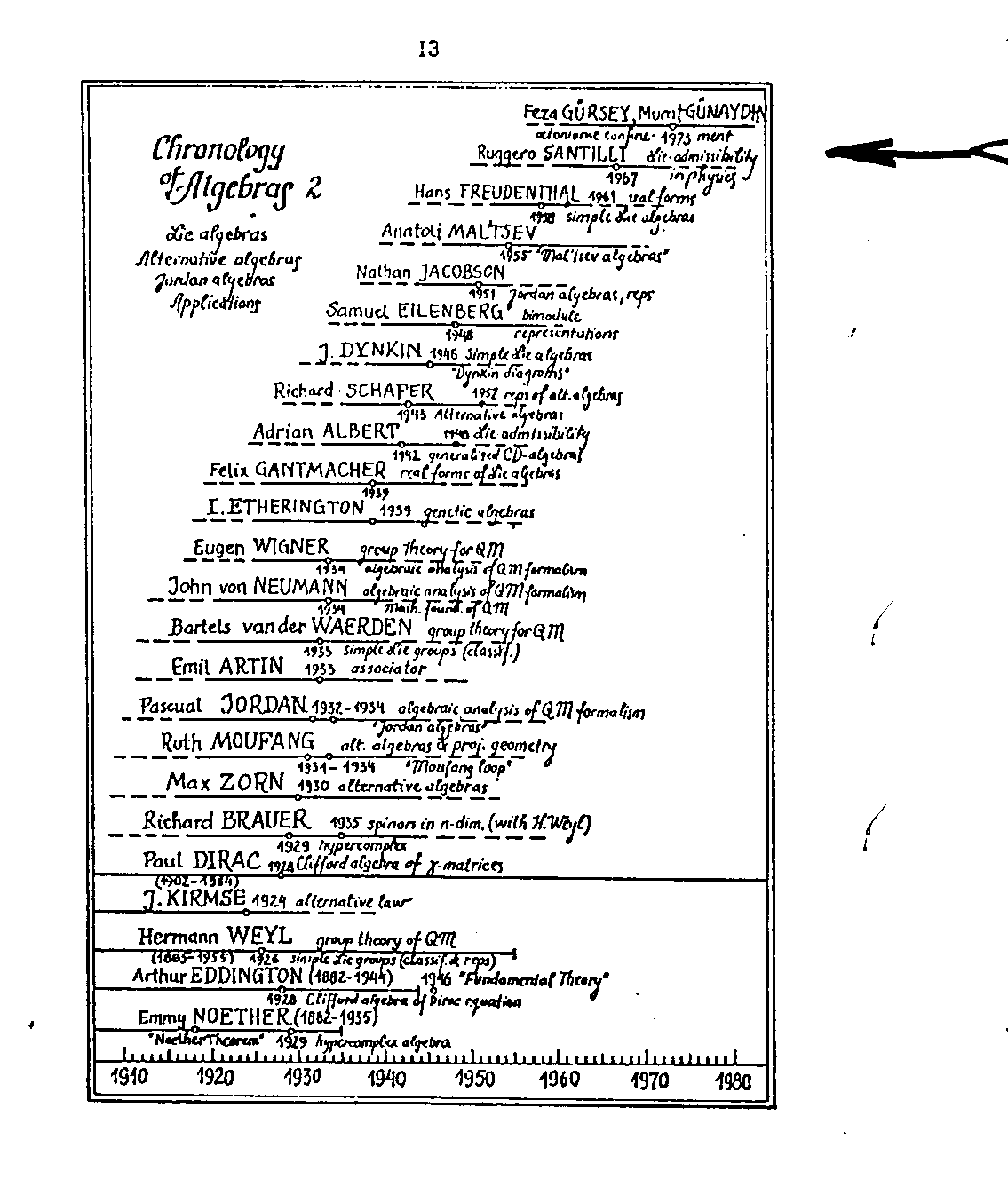
For comparison, several other mathematicians have discovered individual mathematical structures, for instance, Hamilton discovered the quaternions, Jordan discovered his algebras, and Lie discovered his theory, but no other mathematician in history discovered, as Prof. Santilli did, structural generalizations of the totality of mathematics in sequential series [isotopic, genotopic, hyperstructural and isodual].
For free pdf download of some of the numerous articles in Italian, please click below
Article 1
Article 2
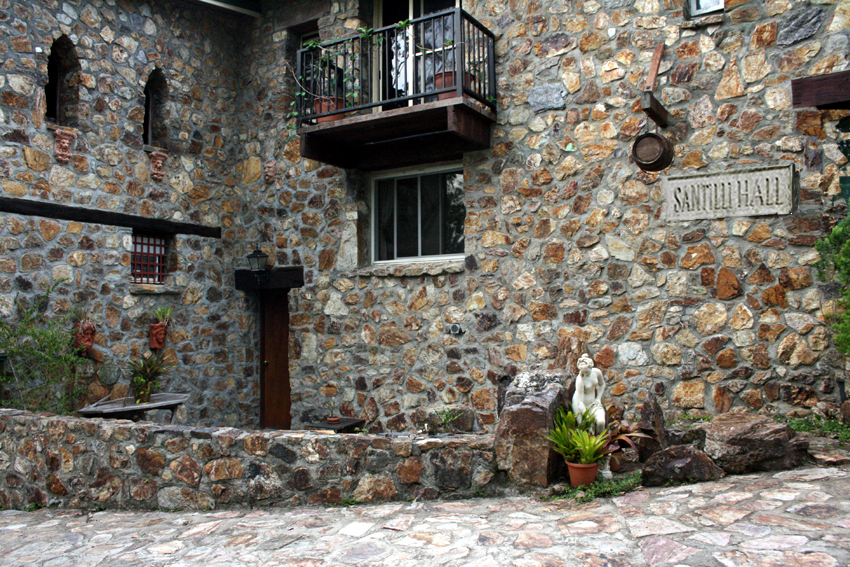
SANTILLI HALL AT THE
SCIENCE ART RESEARCH CENTER
IN AUSTRALIA

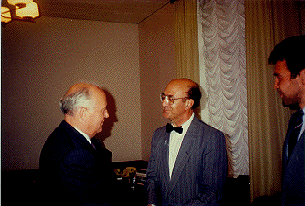
On July 5, 1992, soon following the fall of communism in Russia, Prof. Santilli travels to Moscow where he is received for a twenty minutes long private meeting with former President Mikhail Gorbachev to discuss the future of science in Russia.
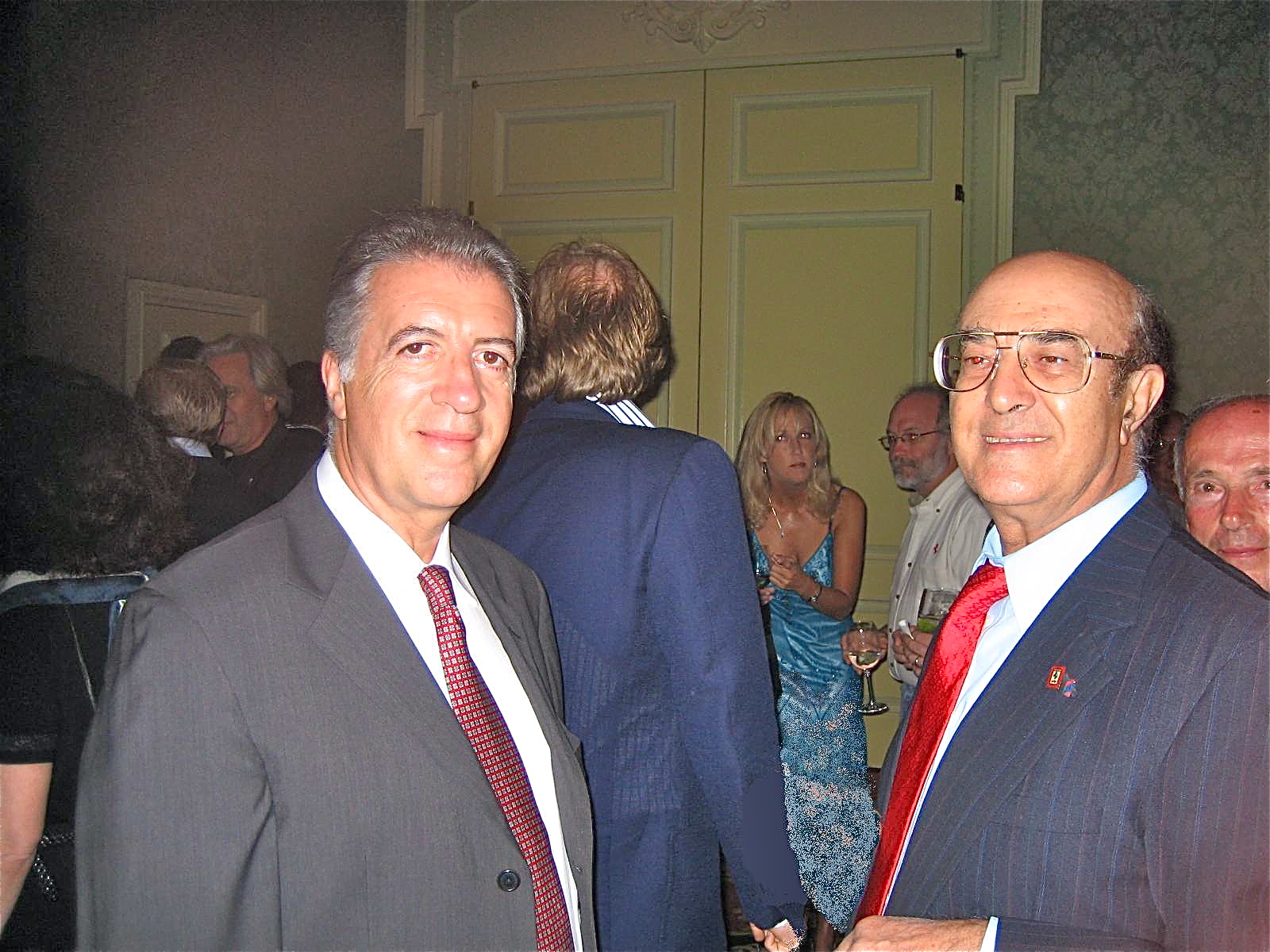
On January 22, 2002, during a Ferrari Meeting in West Palm Beach, Florida, Prof. Santilli meets Franco Lardi Ferrari, the son of Enzo Ferrari, to discuss the environmental problems caused by gasoline combustion and the new technologies needed for their resolution.
PROF. SANTILLI RECEIVED THE
PRESTIGIOUS
MEDITERRANEAN PRIZE
previously awarded to Hilary Clinton, Price Albert of Monaco, France President Nicolas Sarkozy,
King Juan Carlos King of Spain, Architect Renzo Piano, and other famous people.
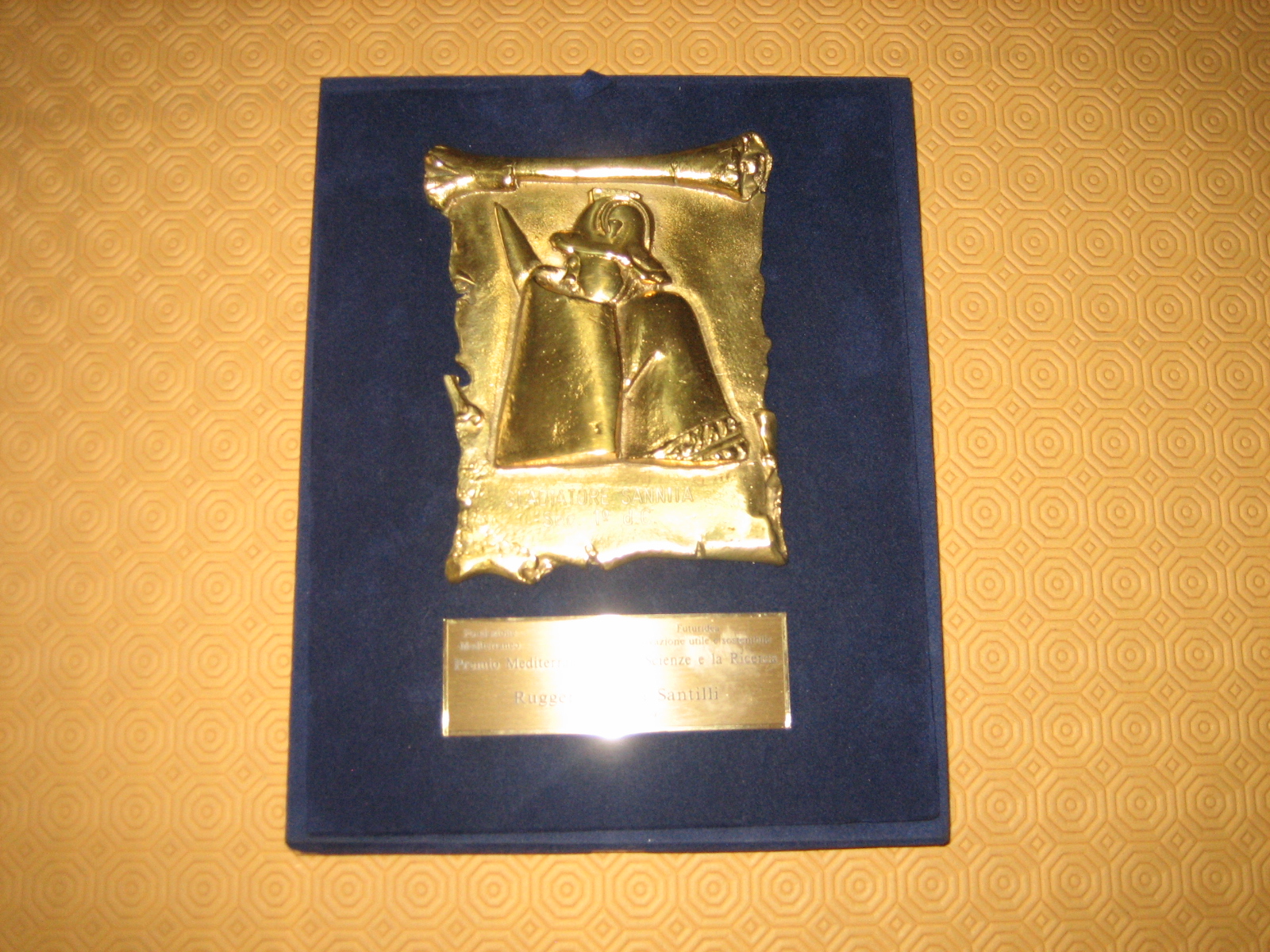
The Gold Prize for Scientific Discoveries received by Prof. Santilli from the Foundation Mediterranean on January 22, 2009, in Naples, Italy. The gold bassorilievo depicts and carries the script of a Gladiatore Sannita, namely, a gladiator from the Italian region of Sannio in central Italy where Prof. Santilli was born.
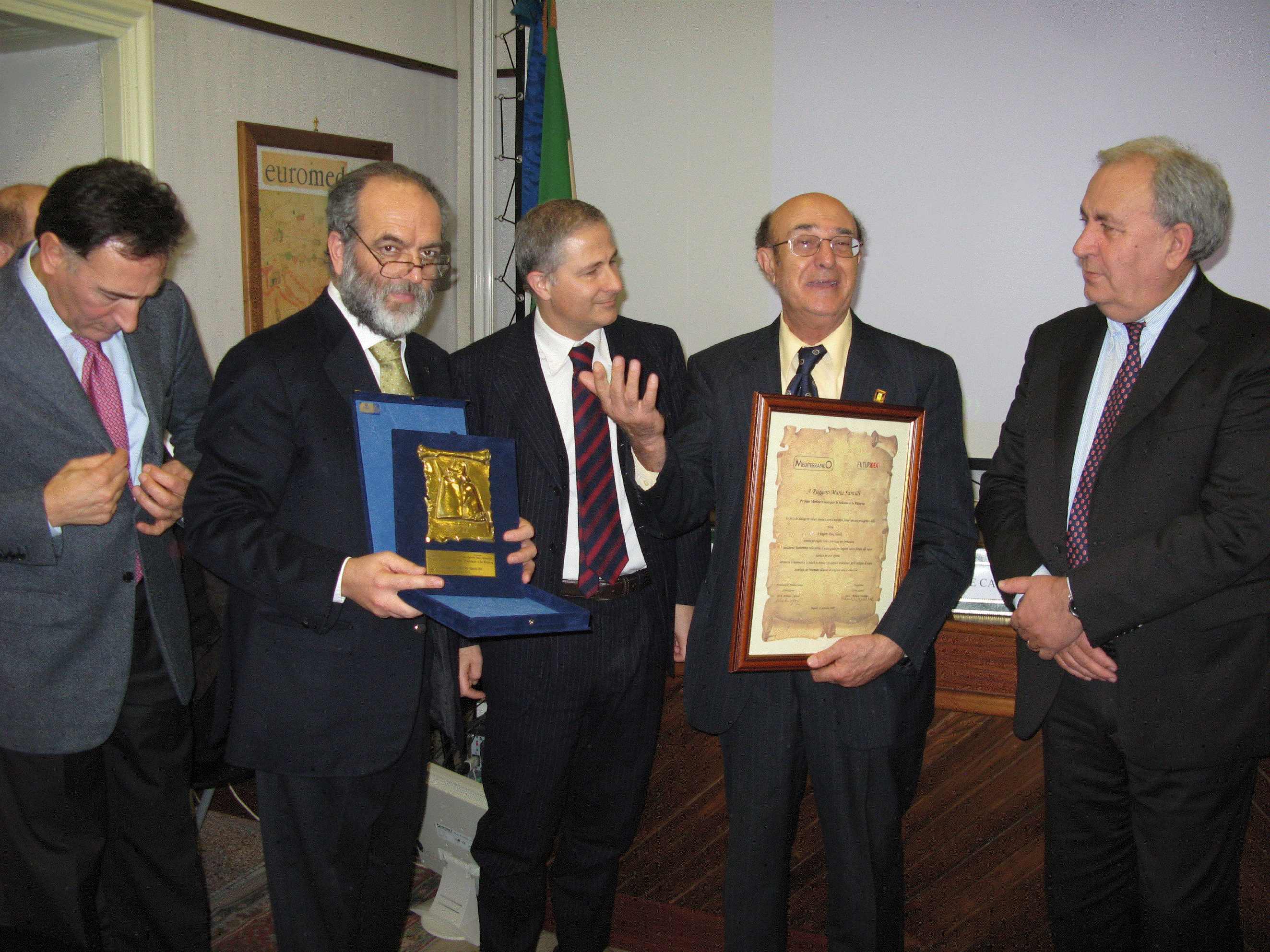
OFFICIAL MOTIVATION
To Prof. Ruggero Maria Santilli we hereby grant this 2009 Gold Price for his scientific discoveries and for advances in mathematics, physics and chemistry that have allowed the development of new technologies for the benefit of new sustainable environmental technologies.
PROF. SANTILLI IS HONORED
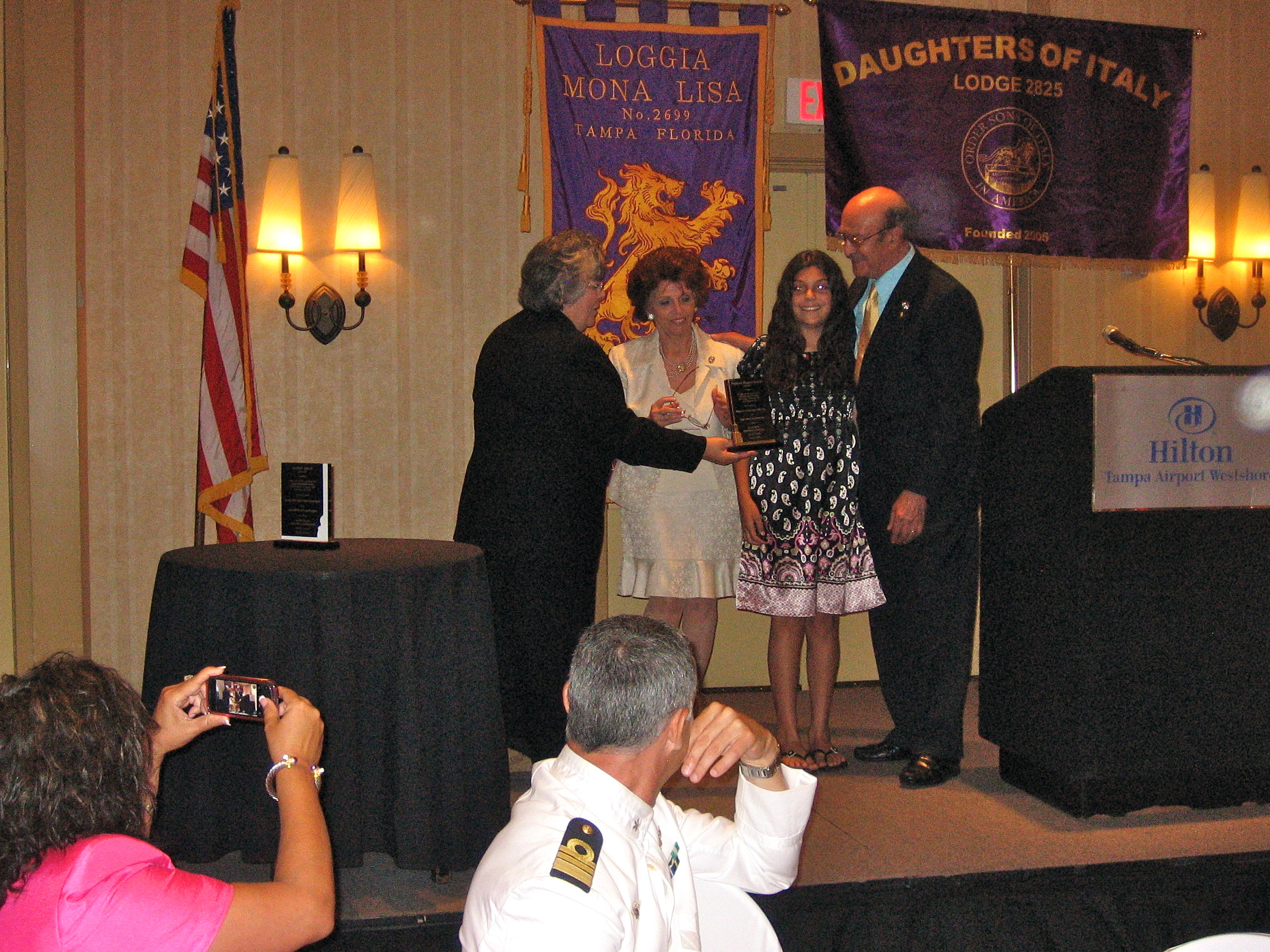
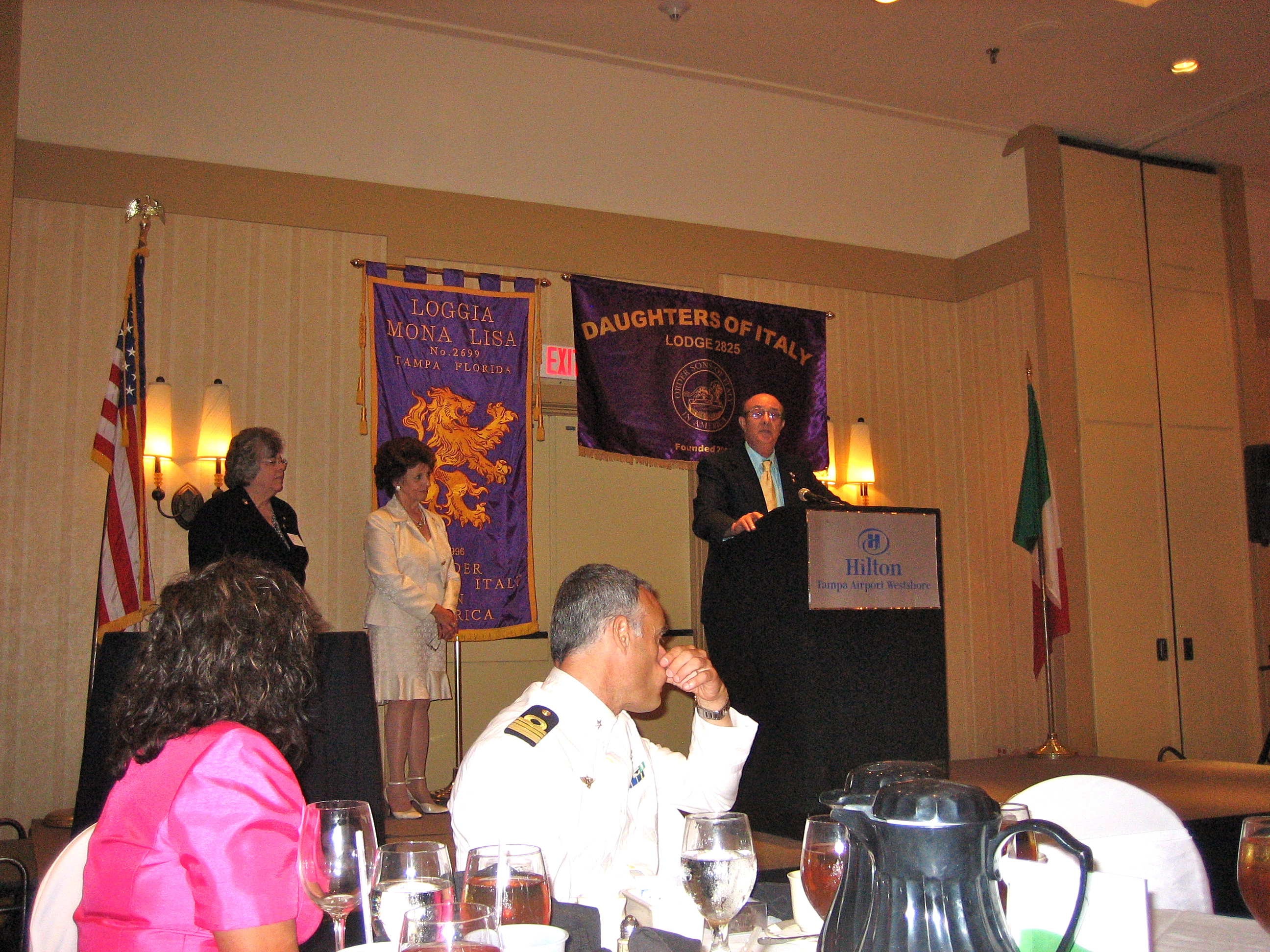
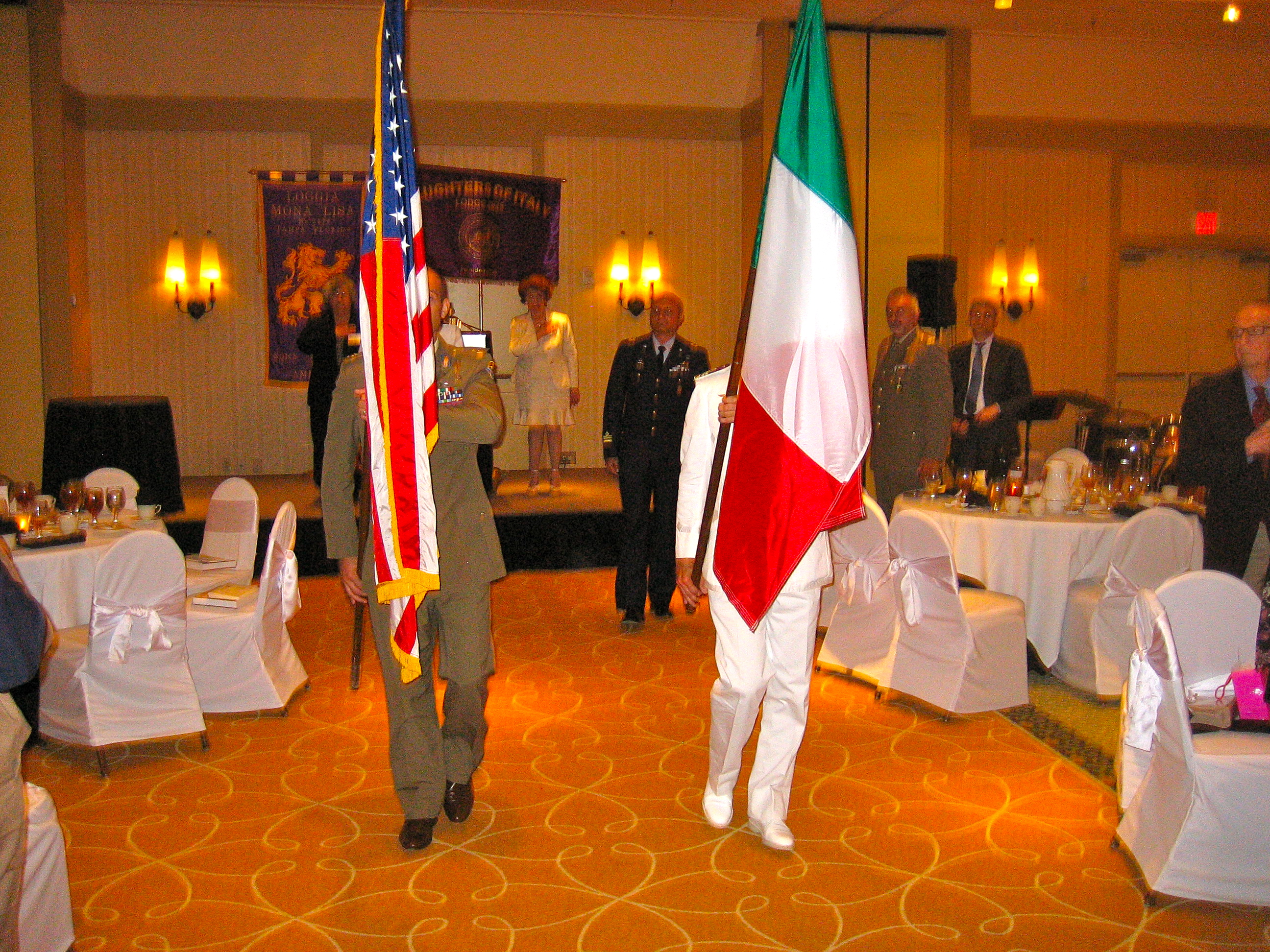
BY THE SONS OF ITALY IN AMERICA
for his lifetime of scientific contributions with particular reference to his discovery of the covering of special relativity known as Santilli Isorelativity, its recent confirmation via experimental measurements of deviations from the Doppler's law within physical media, and their cosmological implications.
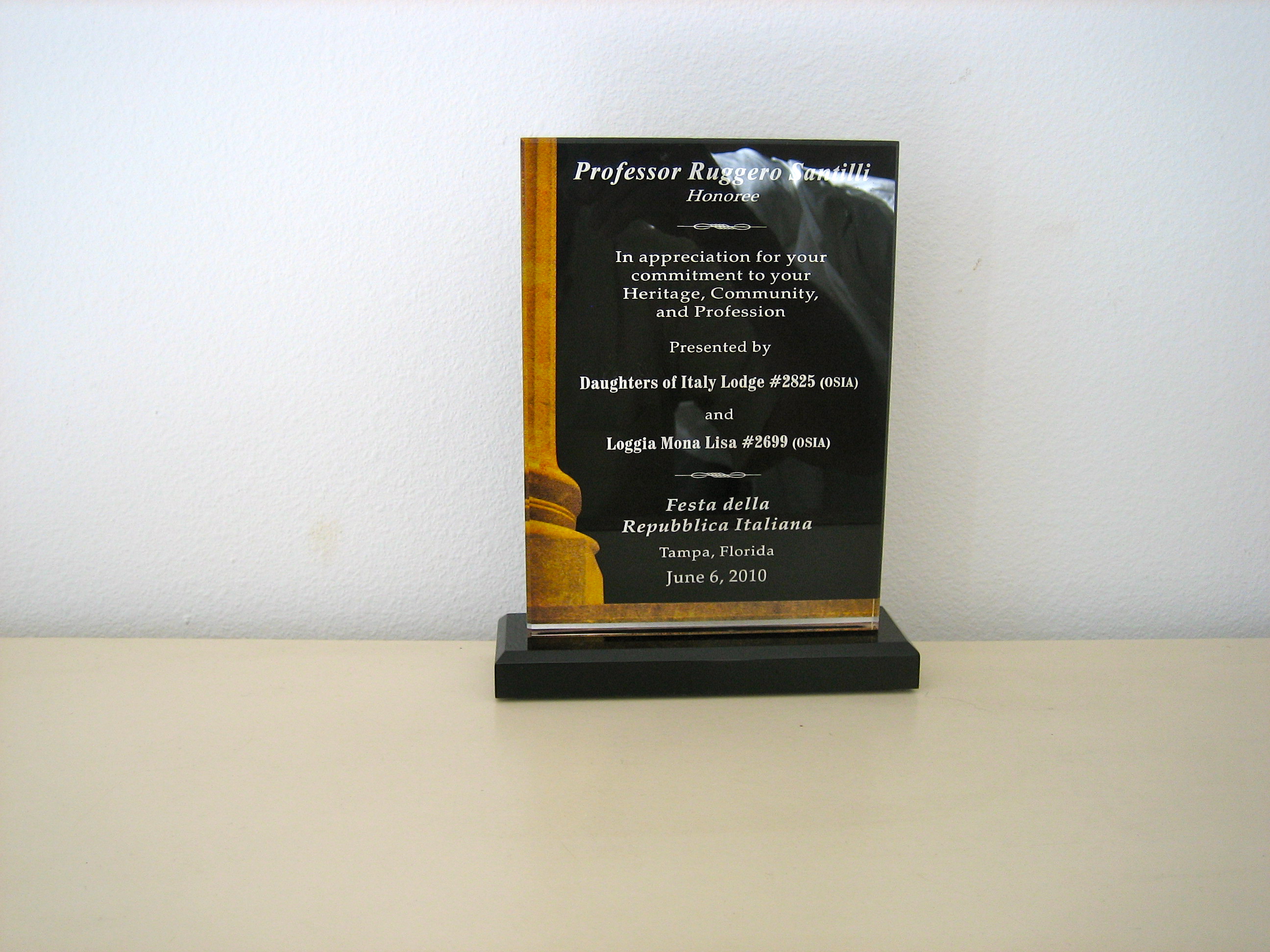
January 7, 2011
PROF. SANTILLI RECEIVED THE 2011 SCIENTIFIC PRIZE OF
KATHMANDU UNIVERSITY, NEPAL, DURING THE
Third International Conference on the Lie-Admissible
Treatment of Irreversible Processes
January 4 to 9, 2011, Kathmandu University, Nepal
http://www.ku.edu.np/iclatip/
September 6, 2011,
PROF. SANTILLI IS KNIGHTED BY THE REPUBLIC OF SAN MARINO
One century ago there was the surpassing of Galileo theories by Einstein relativities. Prof. Santilli pioneered decades ago the surpassing of Einstein theories via new mathematics, physics and experiments that are now at the forefront of science, on which he maintains the world leadership.
The Gran Cross was awarded during the
San Marino Workshop on Astrophysics and Cosmology for Matter and Antimatter September 5 to 9, 2011, on which Prof. Santilli was the invited keynote speaker for both, matter and antimatter, as shown by the Schedule and the Summaries of Results available in the workshop website..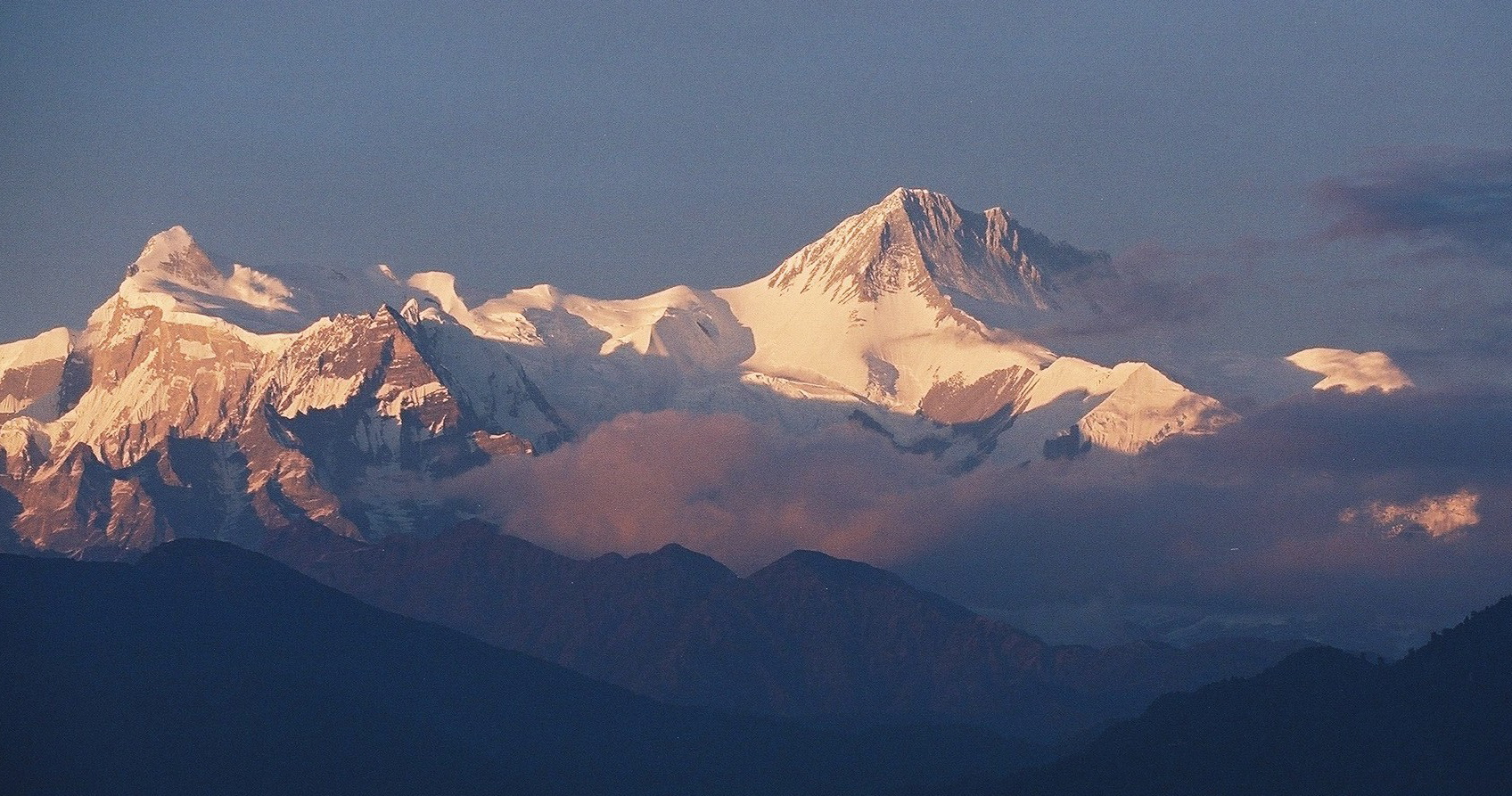
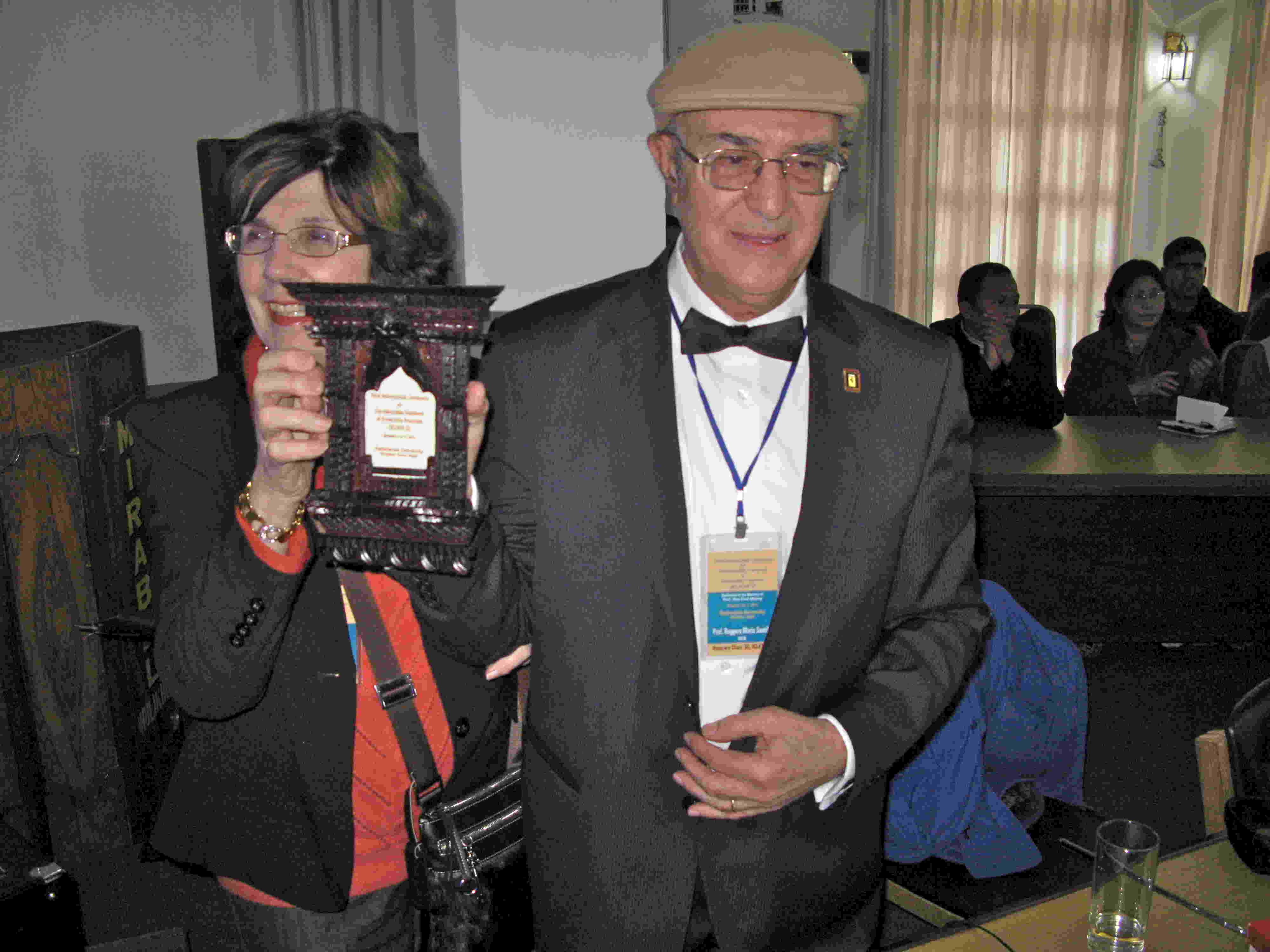
The prize granted to Prof. Santilli during the conference sessions.
Prof. Santilli at the reception of the Nepal Scientific Prize on January 9, 2011, Kathmandu, Nepal.
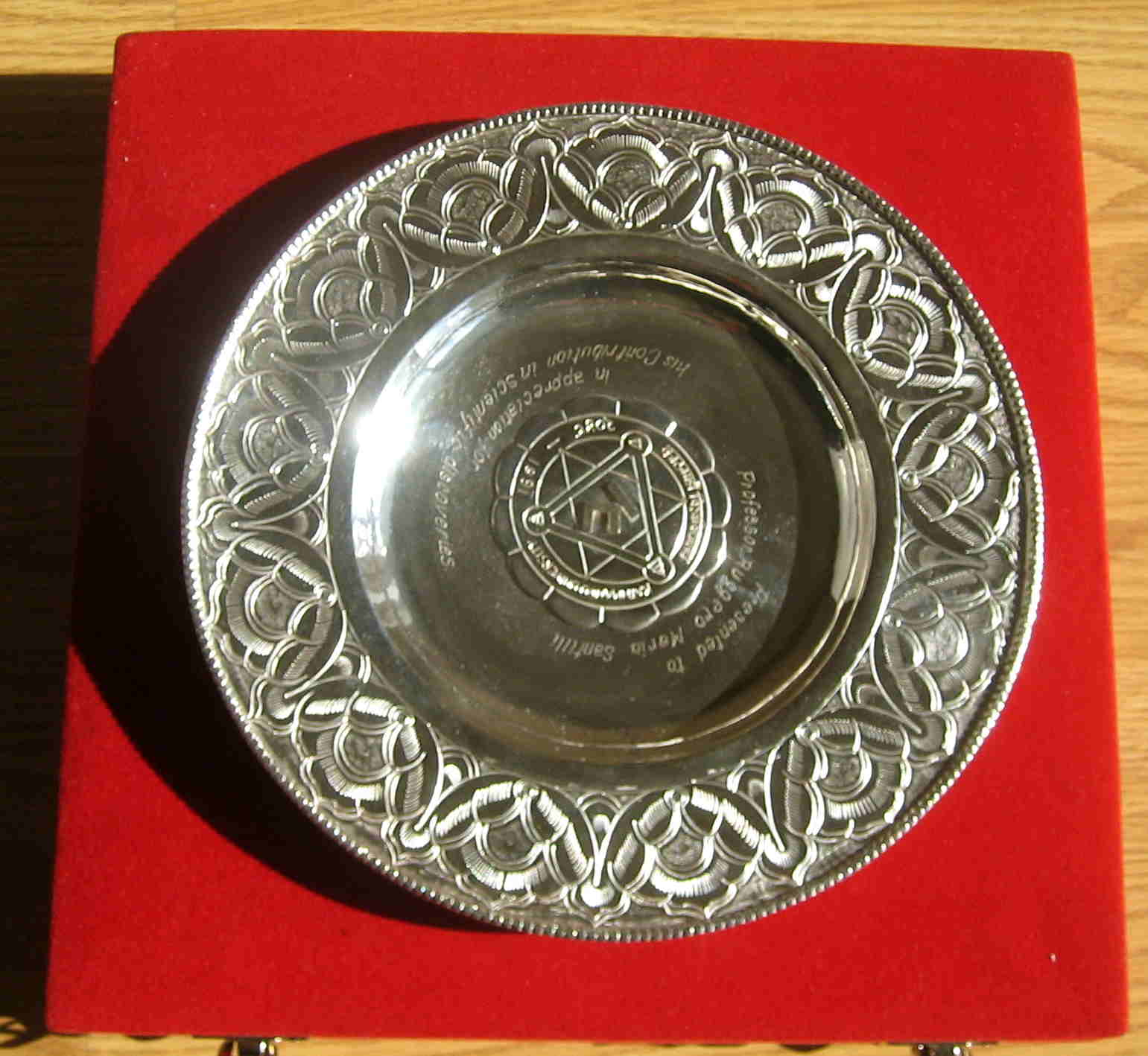
The Silver Commemorative Place carrying the name of Prof. Santilli
and that of Kathmandu University.
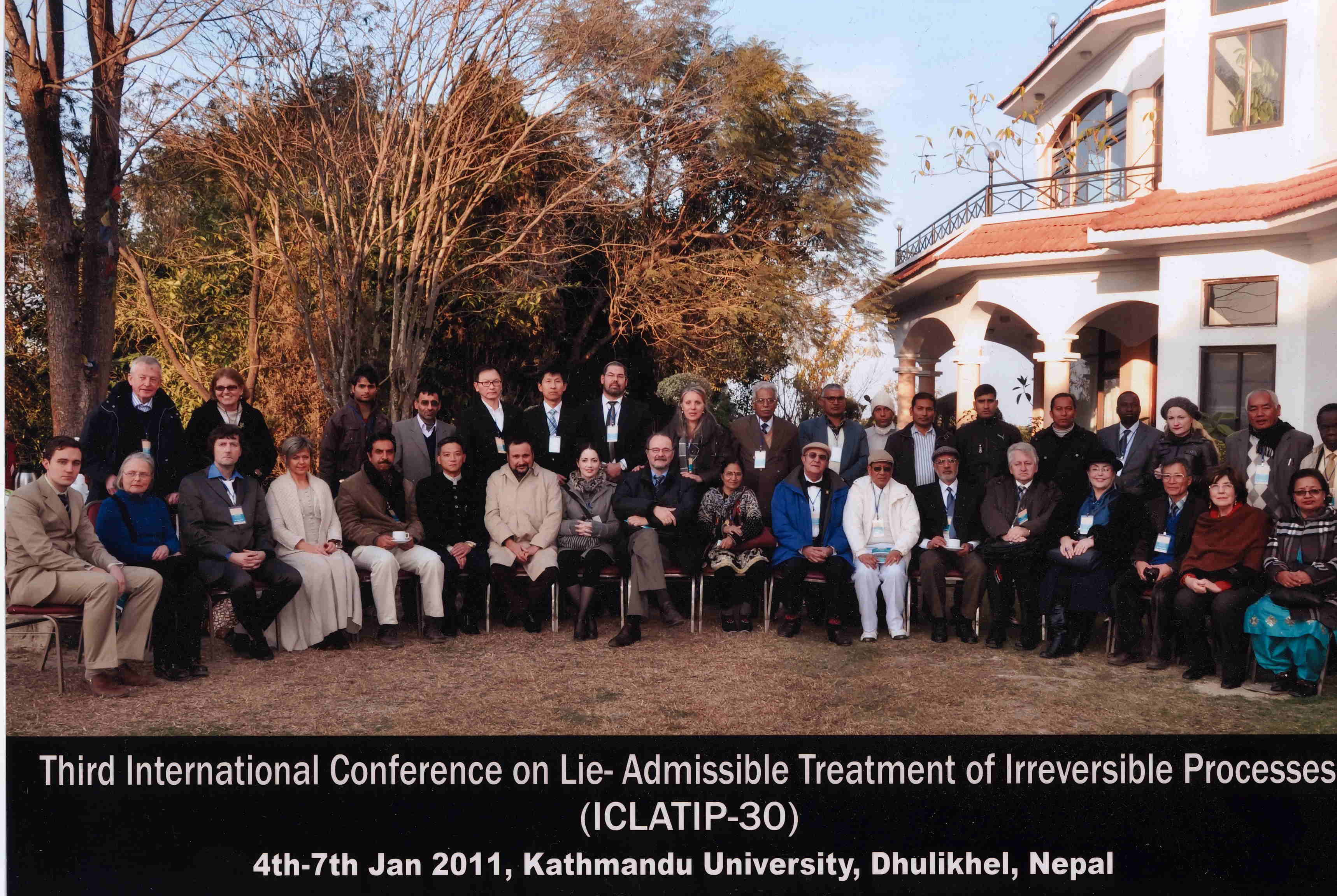
Some of the participants of the 2011 Nepal Conference.
WITH THE MEMBERSHIP TO THE MILLENARY "EQUESTRIAN ORDER OF SANT'AGATA"
AND THE TITLE OF SIR
during an official ceremony at the Palazzo Pubblico the honor being granted by His Excellency the Secretary of State, Dott. Augusto Casali, in representation of the Eccellentissimi Capitani Reggenti of the Republic, with the following motivation:
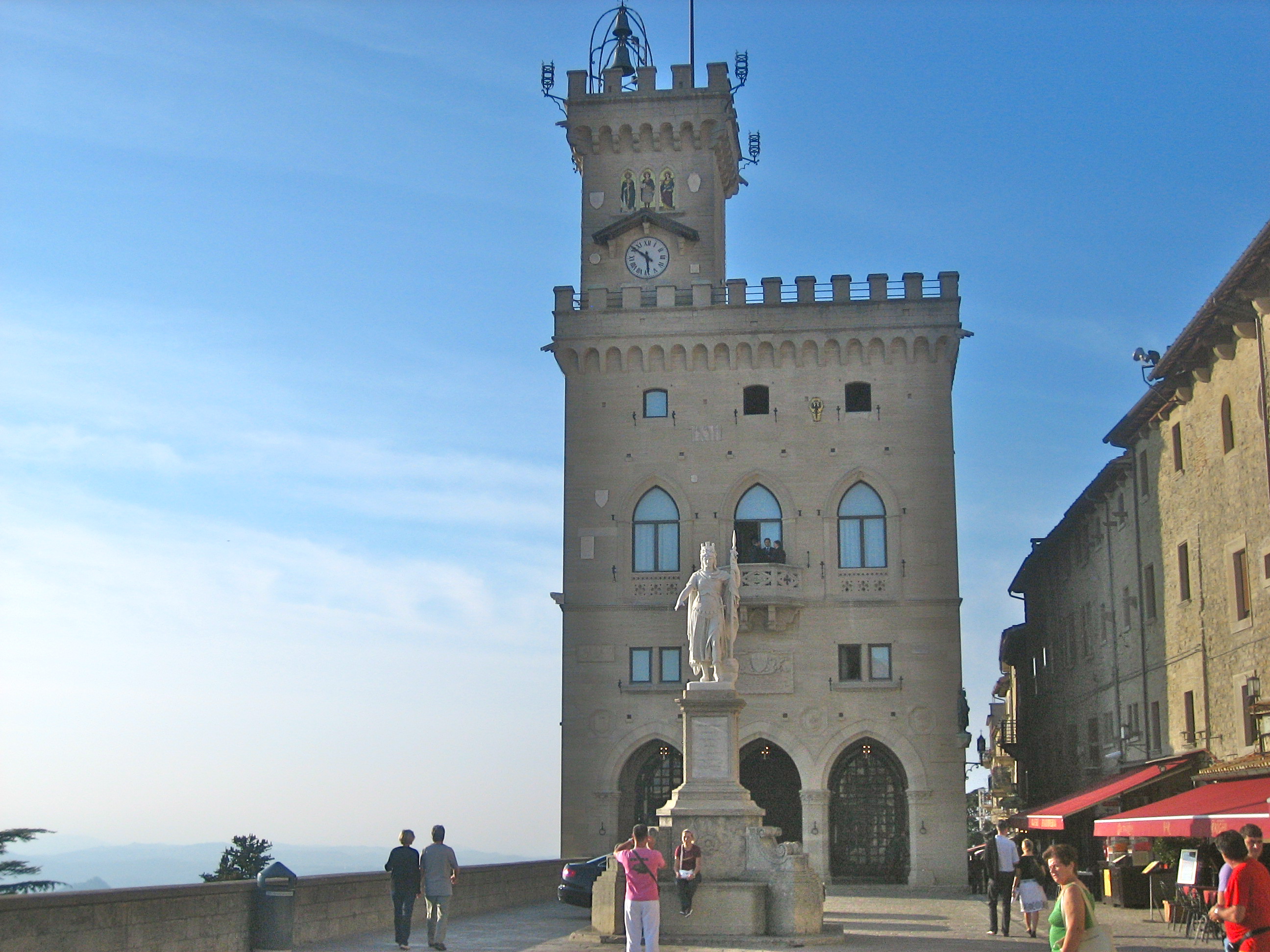
The Palazzo Pubblico of the Republic of San Marino
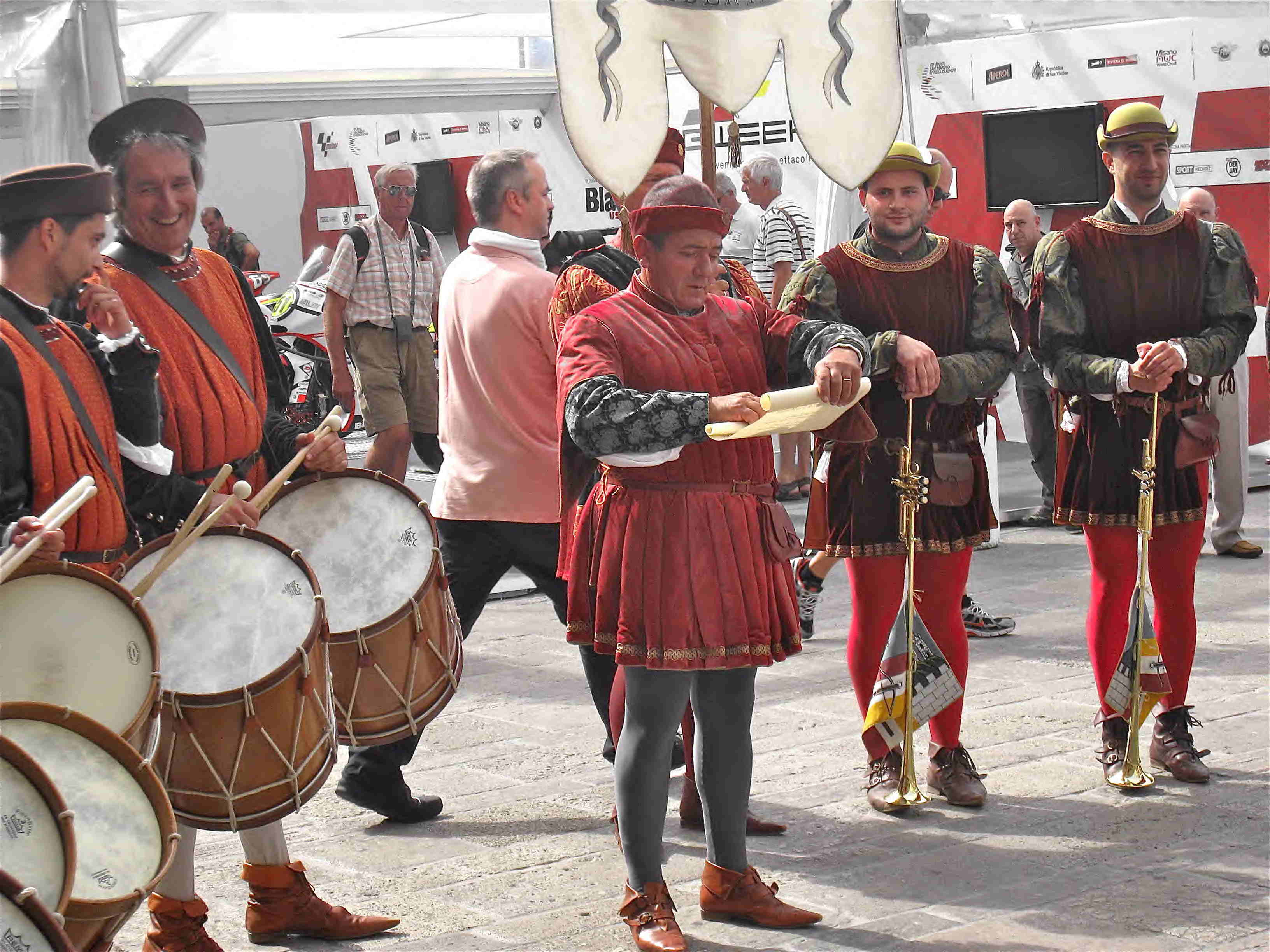
The nice pageantry of public announcements in San Marino.
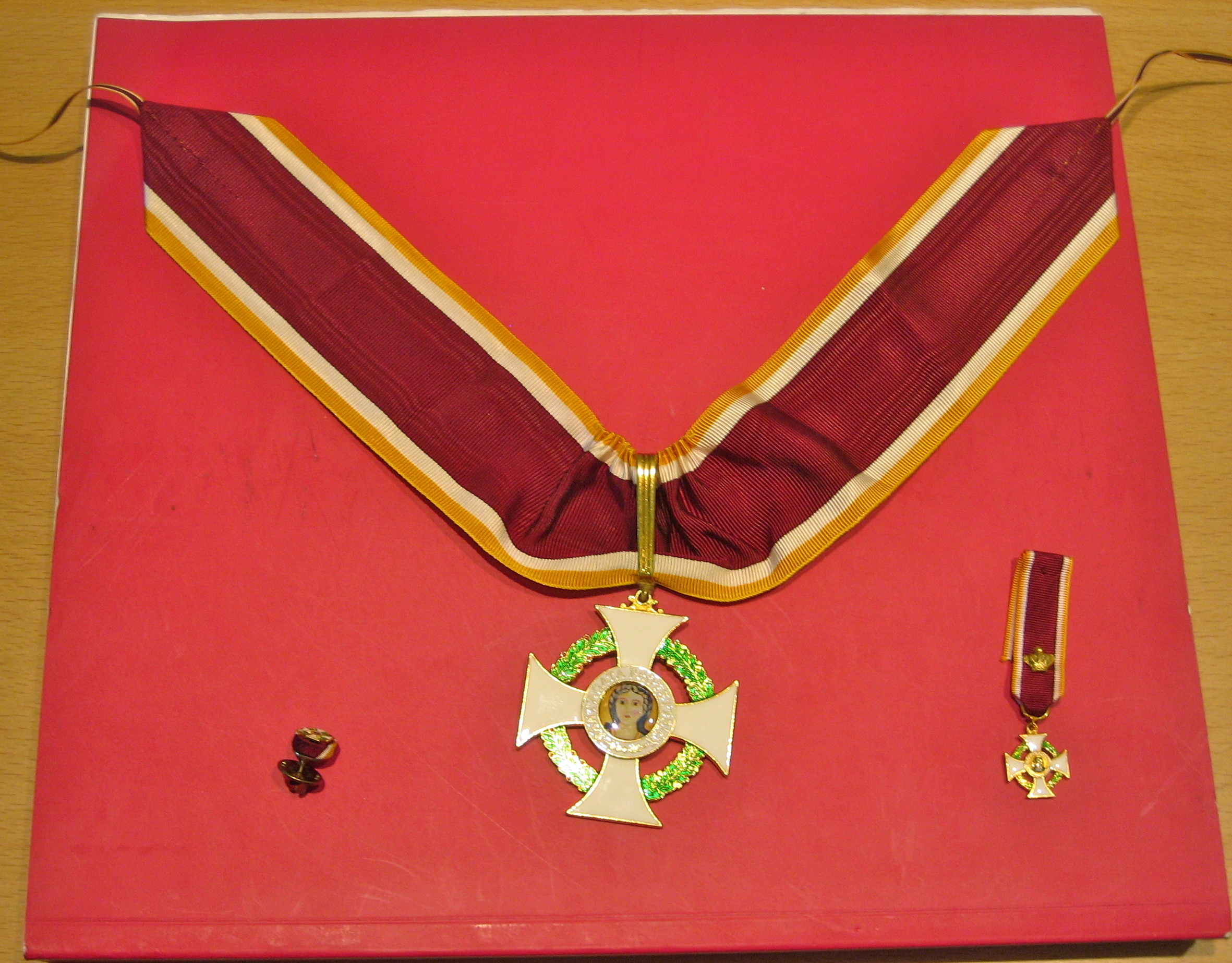
The Grand Cross of St. Agata Order and the lapel decoration
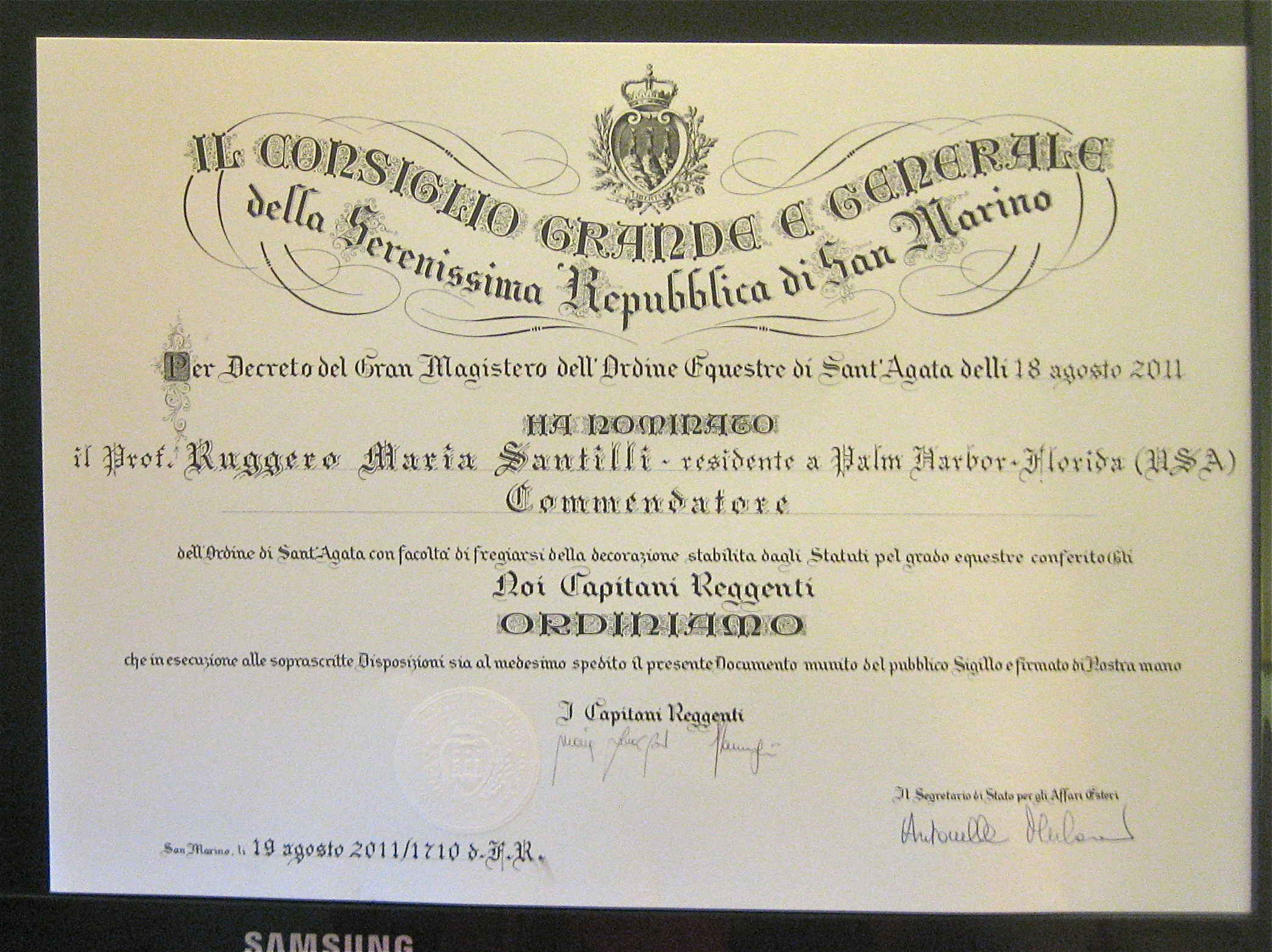
The official decree of the Grand Council of the Republic of San Marino bestowing to
Prof. R. M. Santilli the Grand Cross of the St. Agata order
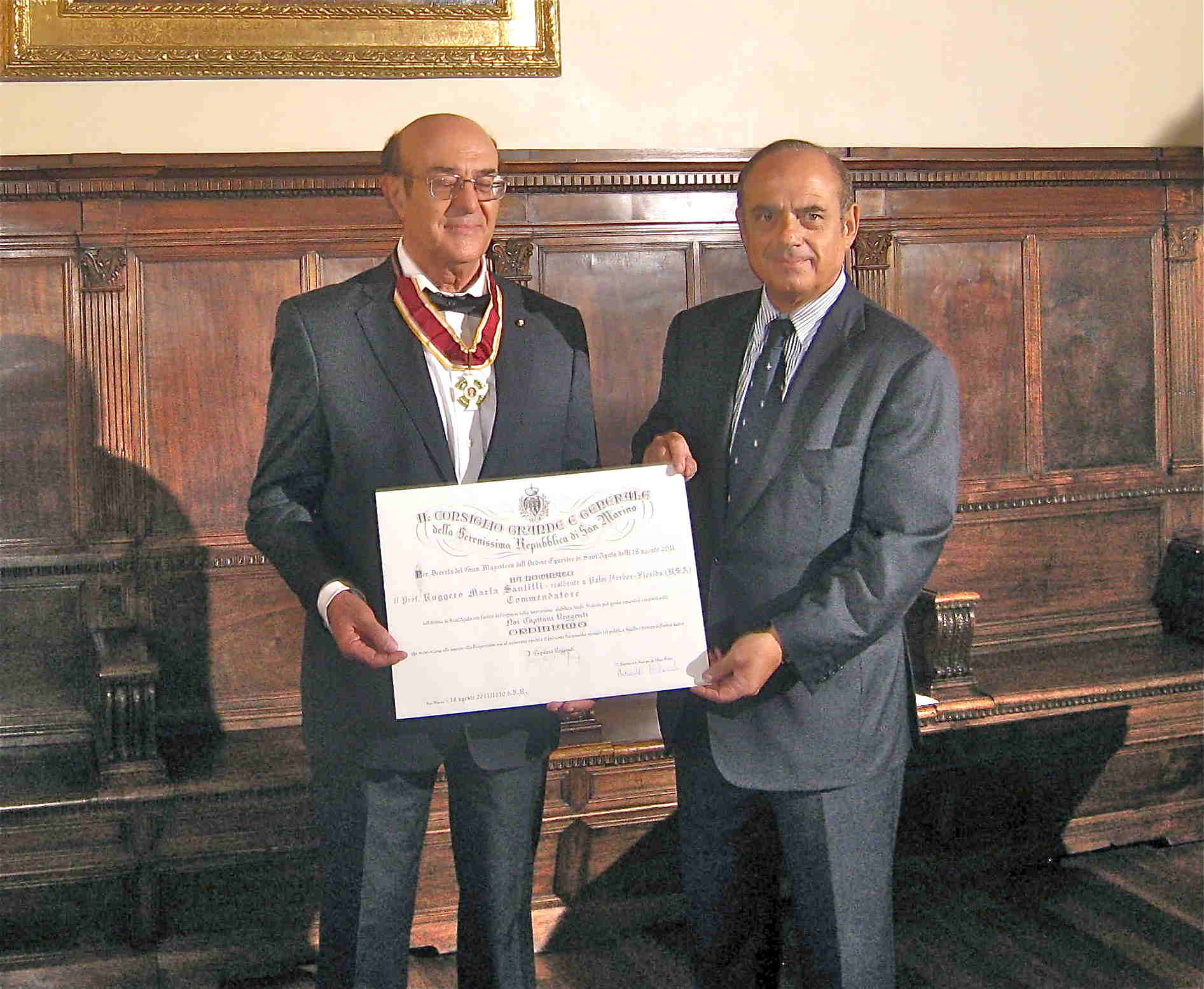
The awarding by His excellency, Dott. Augustoi Casali, Secretary of State.
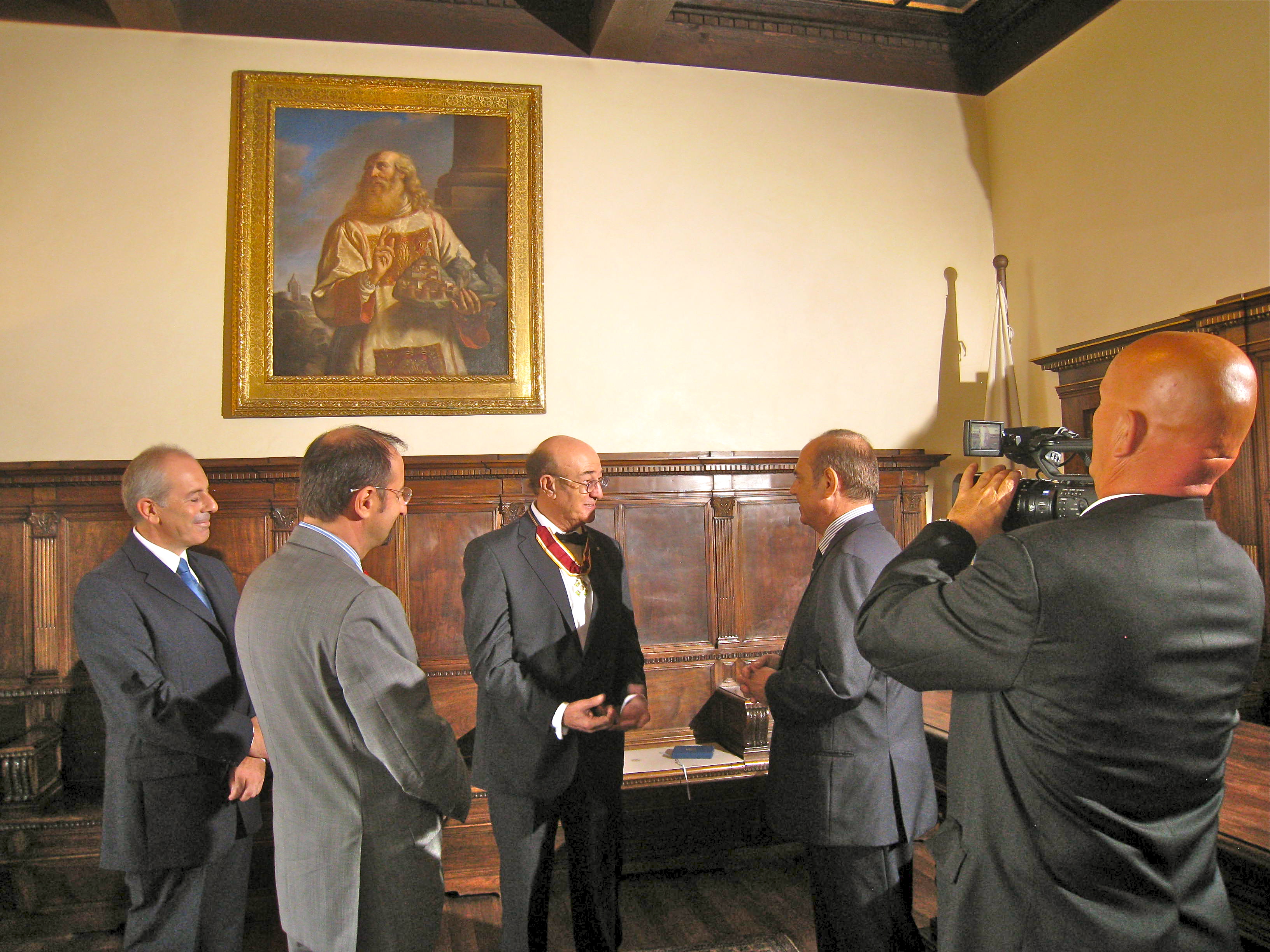
Presenting the Motivation of the award.
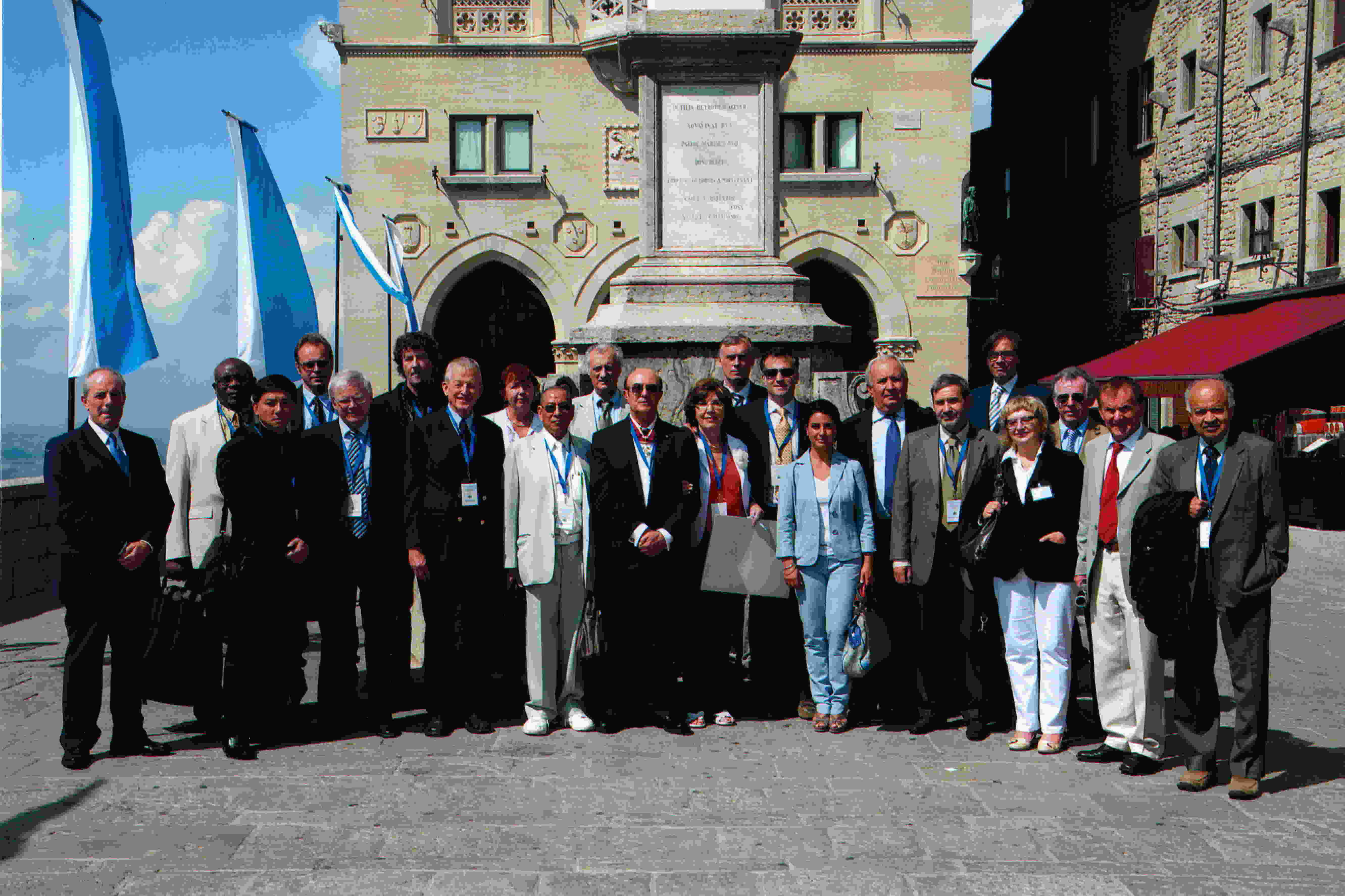
A view of some of the participants of the
2011 San Marino Workshop.
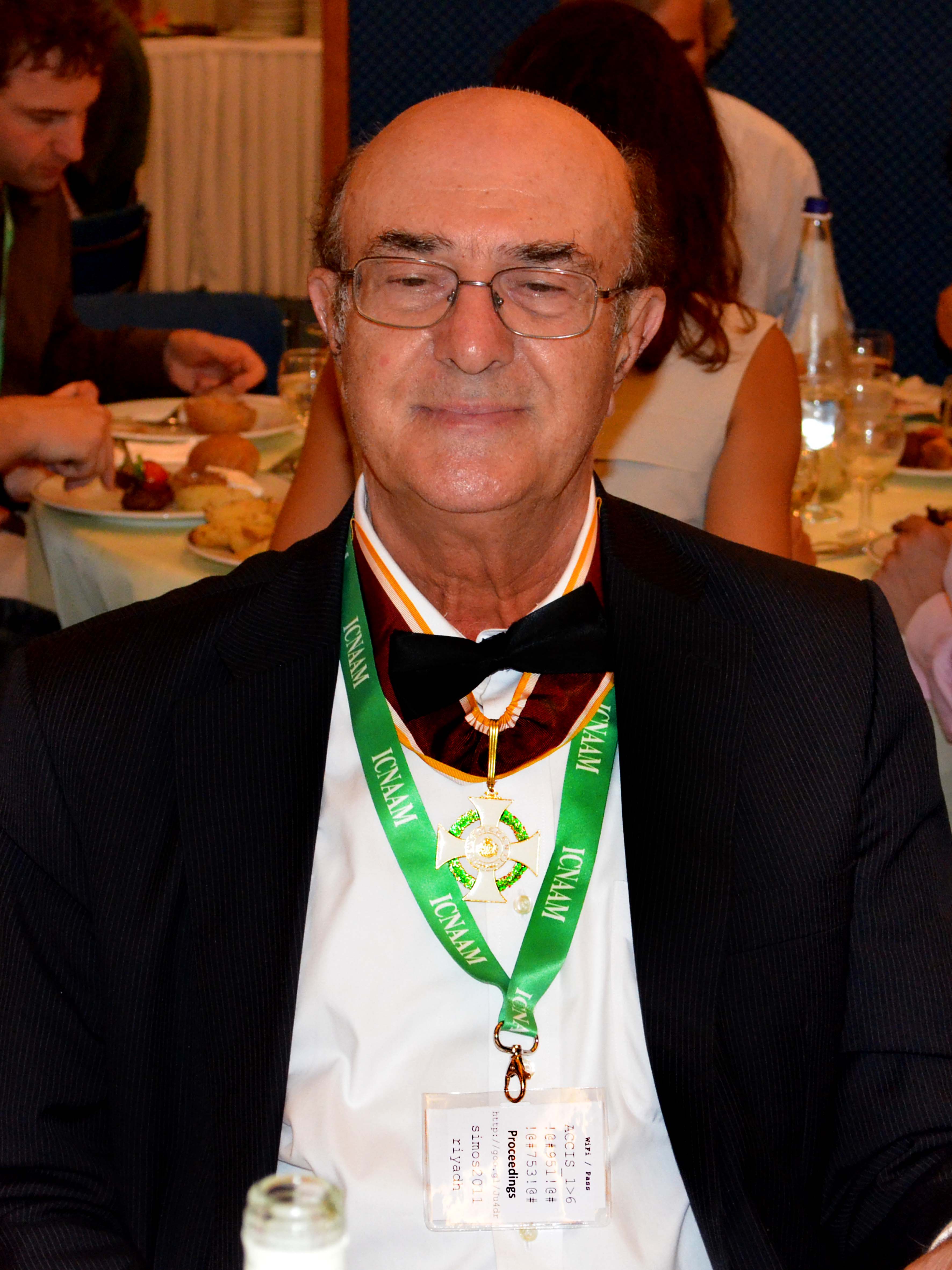
Prof. Santilli while wearing the Grand Cross.
============================================
September 21, 2011,
PROF. SANTILLI RECEIVES THE HIGHEST DISTINCTION OF HONORARY FELLOW OF
THE EUROPEAN SOCIETY OF COMPUTATIONAL METHODS IN SCIENCE AND ENGINEERING FOR
"His outstanding contribution in the field of Applied Mathematics."
The Award was granted during the formal dinner of the 2011 International Conference of the Society
CNAAM 2011, G-Hotels, Halkidiki, Greece, 19-25 September 2011
for which prof. Santilli had been an invited speaker to present his mathematics under the title
An introduction to the novel iso-, geno-, and hyper-mathematics for matter and their isoduals for antimatter.
During this talk, Prof. Santilli presented the new maths, physics and experiments dealing with the causal and invariant treatment of superluminal speeds as presented at the preceding 2011 San Marino Workshop. On September 23, 2011, two days after Prof. Santilli's invited talk, CERN announcement the detection of particles traveling faster then the speed of light in vacuum, which announcement created great interest in Prof. Santilli talk, including an interview by the Greek Television.
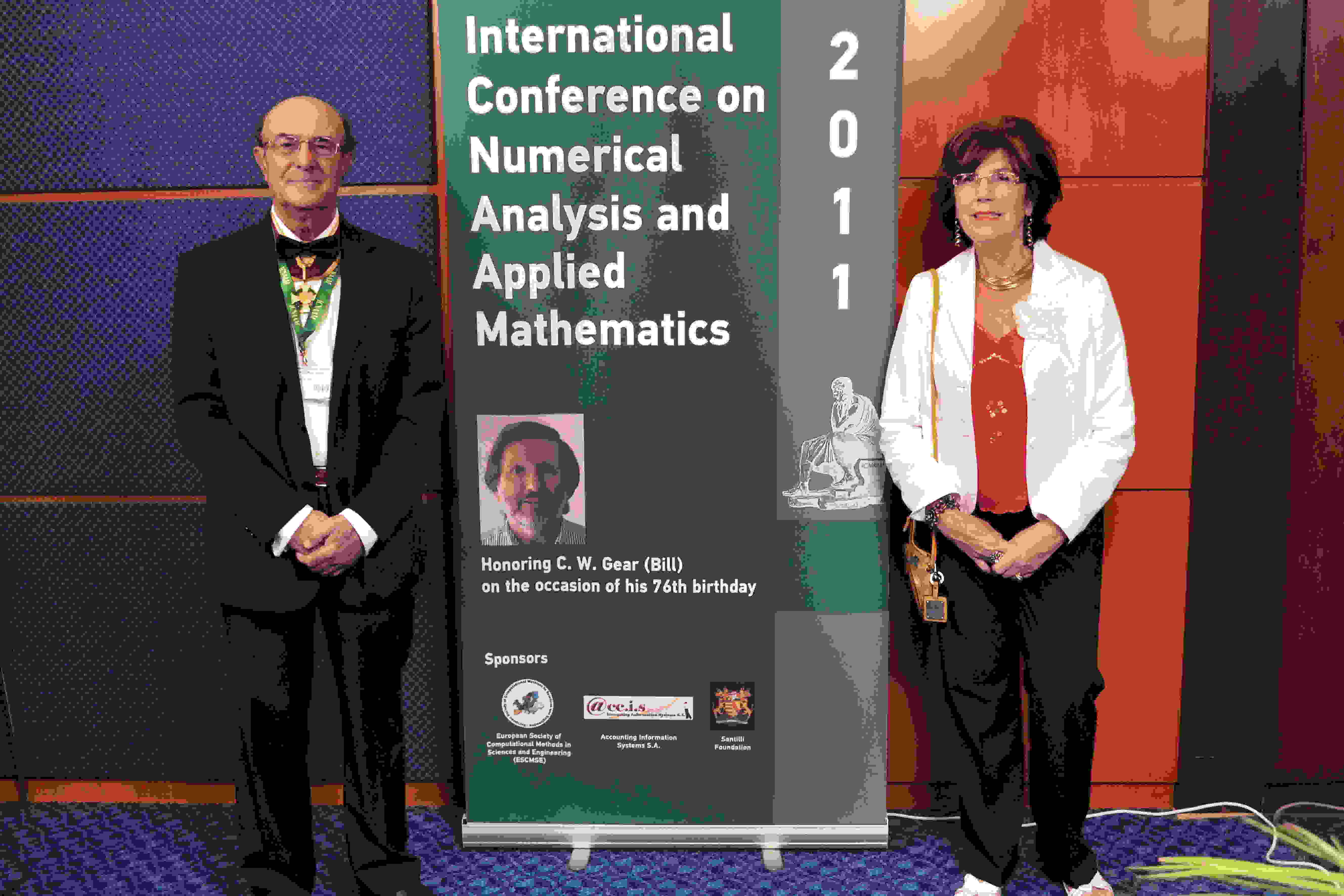
Prof. and Mrs. Santilli with the poster of the 2011 ESCMSE Conference.
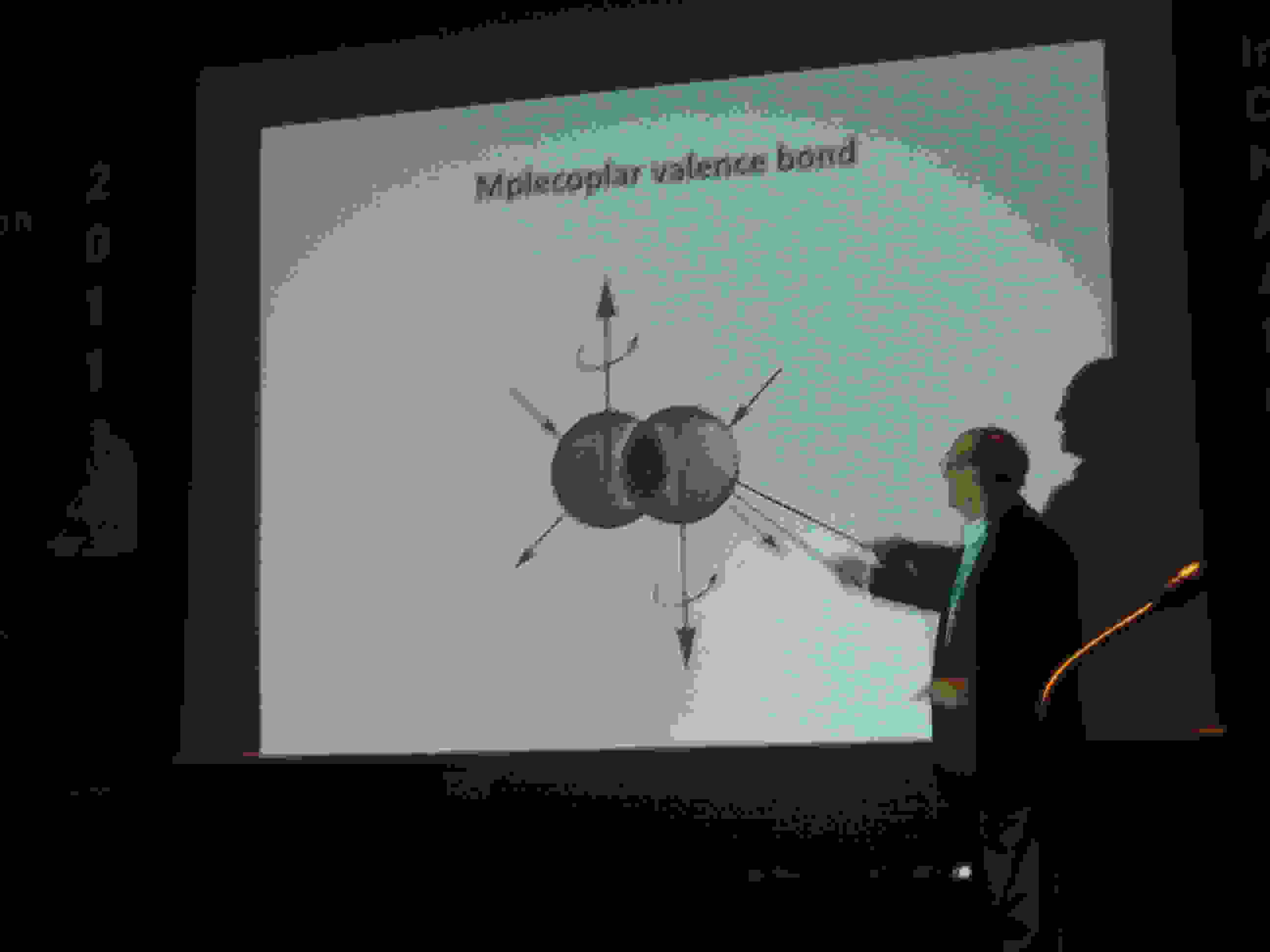
Prof. Santilli during his invited talk, while presenting the first motivation for his nonlinear, nonlocal and nonhamiltonian isomathematics: the representation of electron valence bonds..
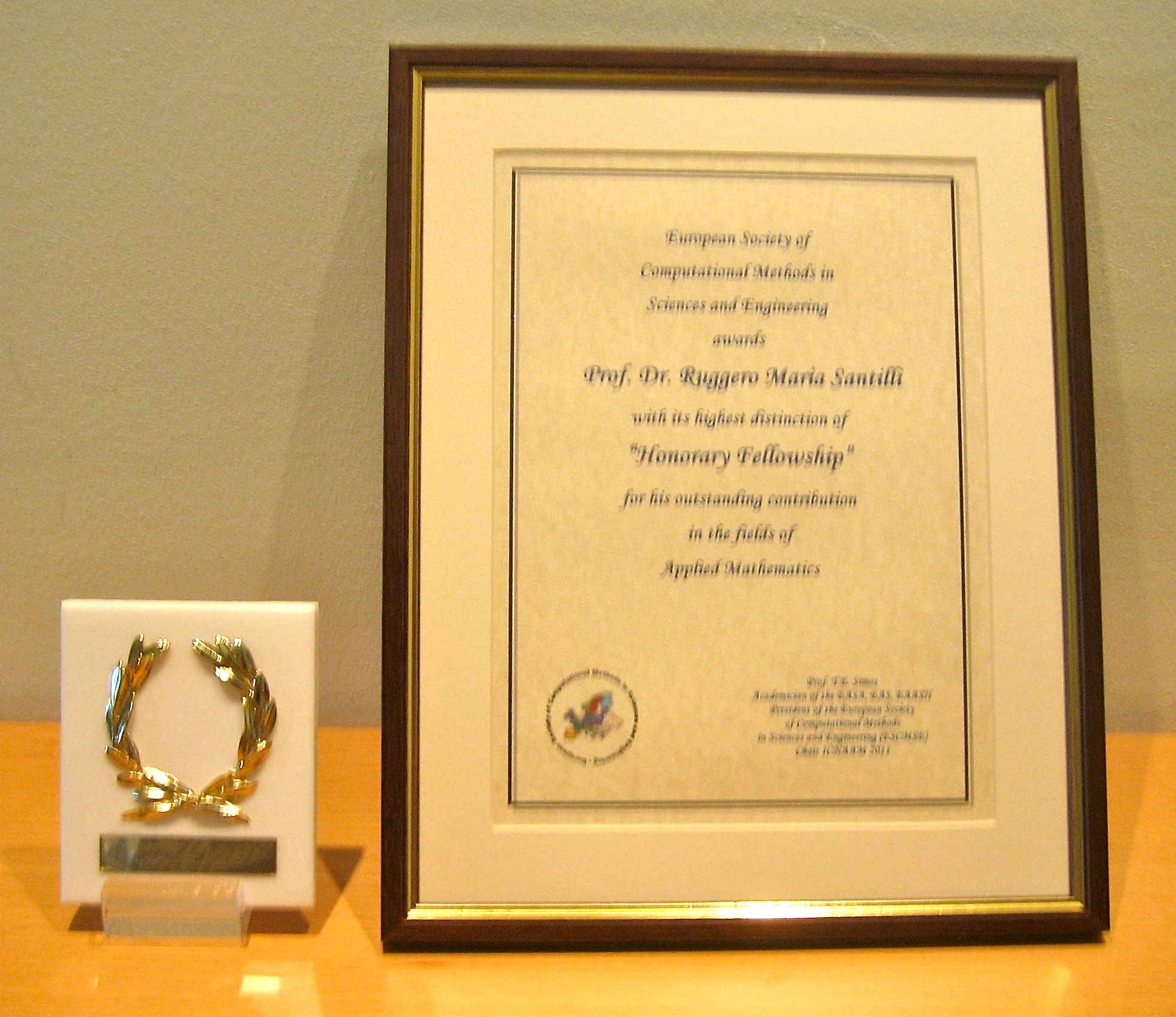
The official diploma of the ESCMSE Fellowship and related memento.
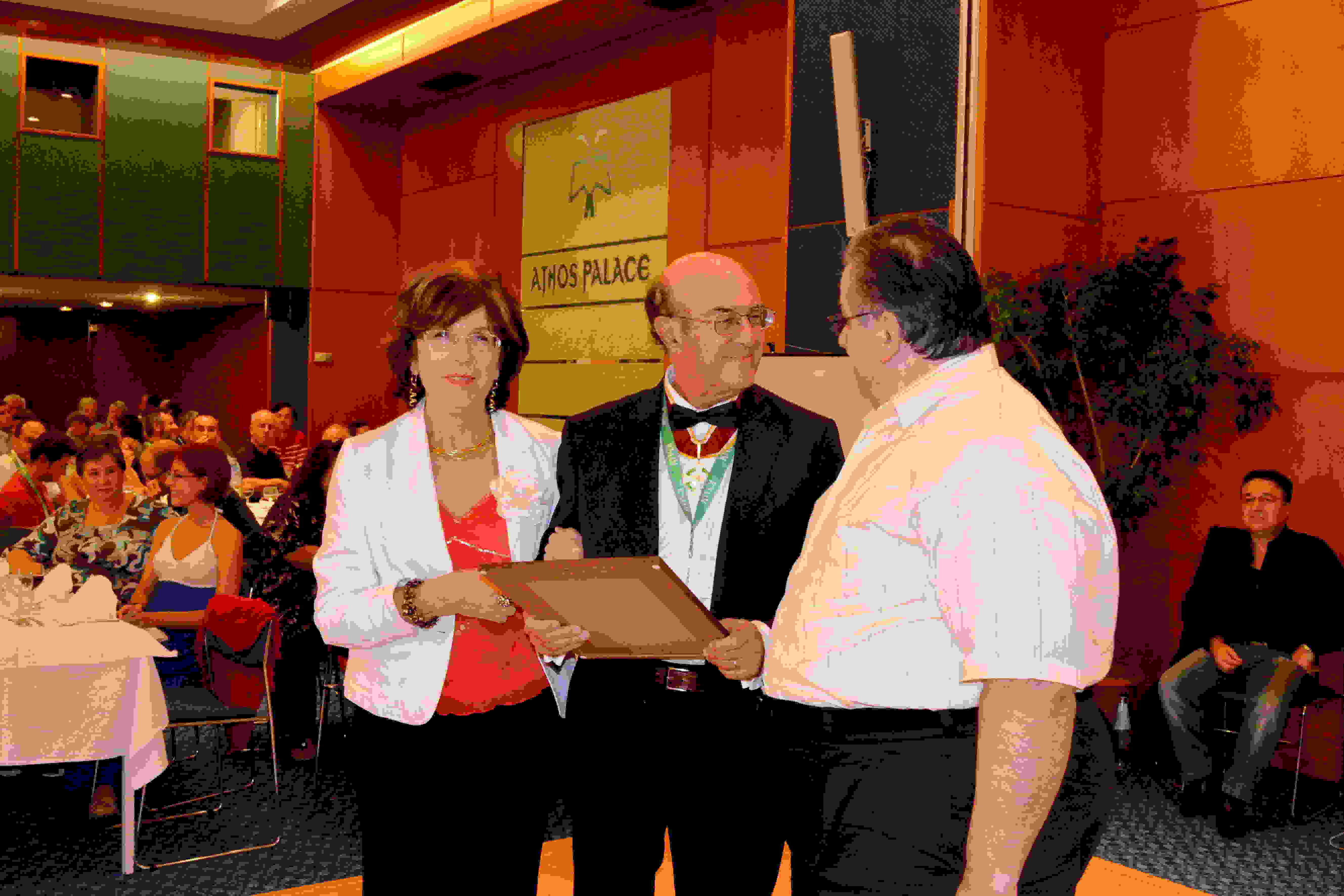
Prof. and Mrs. Santilli at the reception of the 2011 ESCMSE Fellowship.
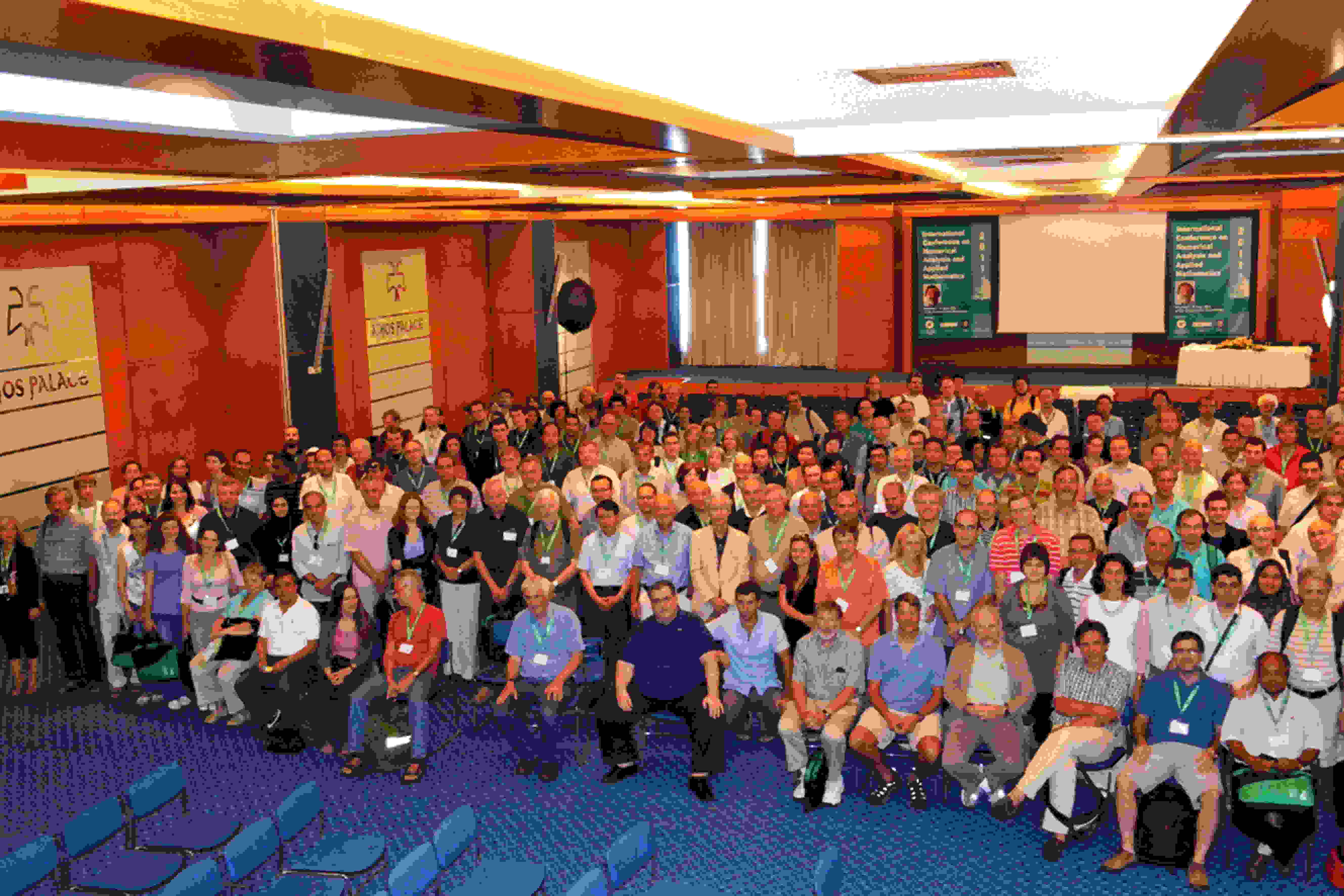
A view of some of the participants to the 2011 ESCMSE Conference. memento.
============================================
July 4-8, 2016,
ICNPAA CONGRESS 2016
University of La Rochelle, France, July 4 to 9, 2016
http://www.santilli-foundation.org/docs/Special-Issue-HM.pdf
Invited Keynote Talk
R. M. Santilli, Outline of the new era in mathematics and its applications
http://www.internationalmathematics.com/icnpaa/schedule/
Special sessions: Santilli new sciences for a new era
http://www.internationalmathematics.com/icnpaa/schedule
Partial list of talks
http://www.santilli-foundation.org/docs/LaRochelle2016-talks.pdf
Technical Achievement Award to Prof Ruggero Maria Santilli
co-sponsored by the Universite' de la Rochelle,
American Institute of Aeronautics and Astronautics
The International Federation of Non-Linear Analysis
International Federation of Information Processing
American Institute of Physics.
Data and pictures to be uploaded in the web page
on Prof. Santilli prizes and Nominations
http://www.santilli-foundation.org/santilli-nobel-nominations.html
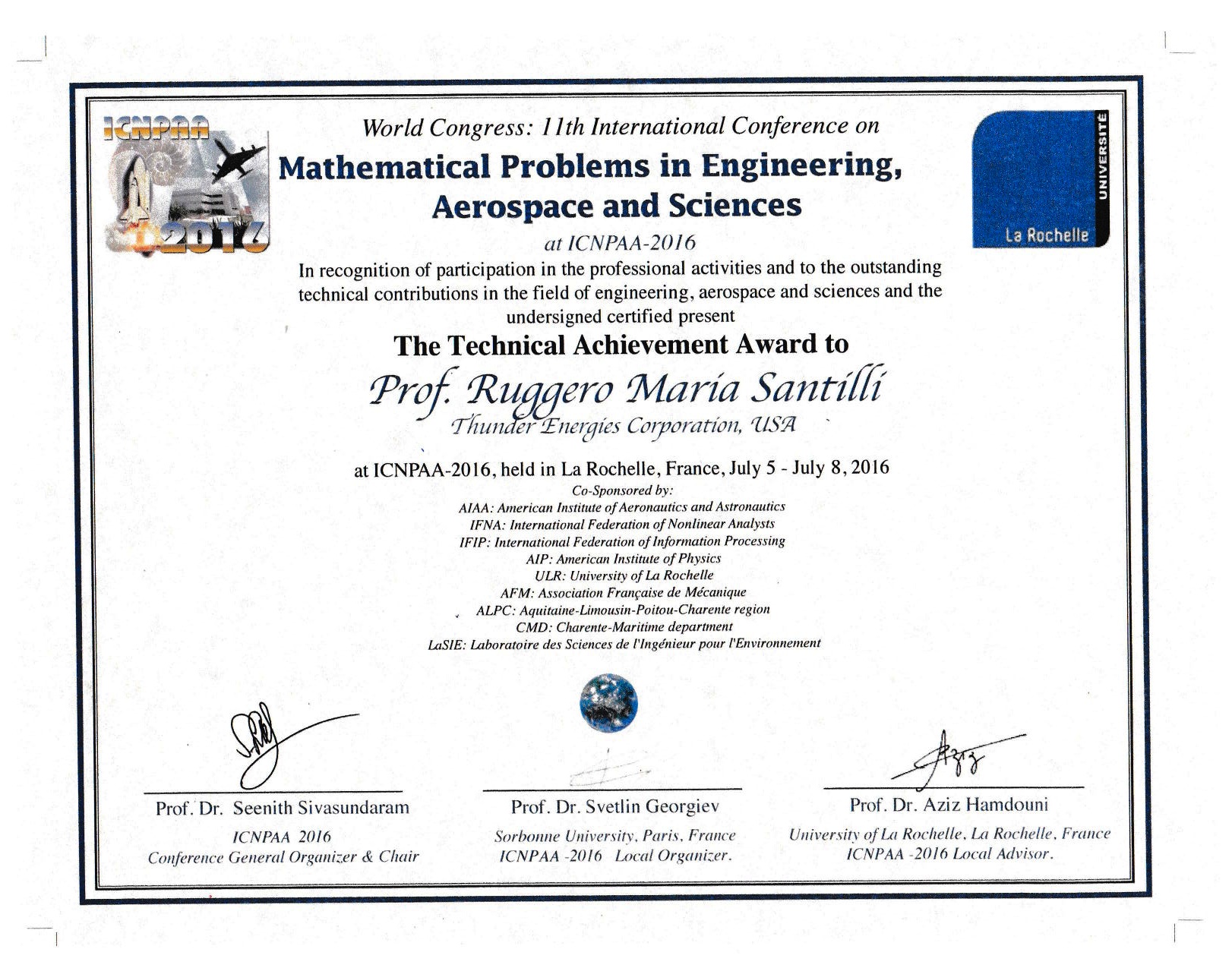
A view of Prof. Santilli's award from the University of La Rochelle, France, under important sponsorships.
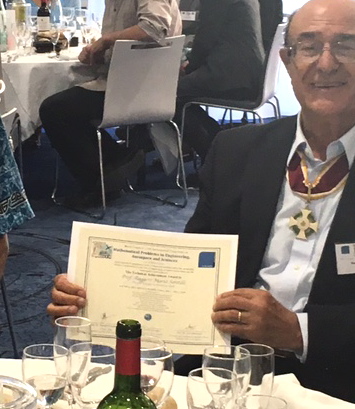
Prof. Santilli at the time of the reception of the 2016 award from the University of La Rochelle while wearing the prestigious Grand Cross of the Sant'Agata Order with the title of Sir received on September 6, 2011, from the Republic of San Marino 9see above).
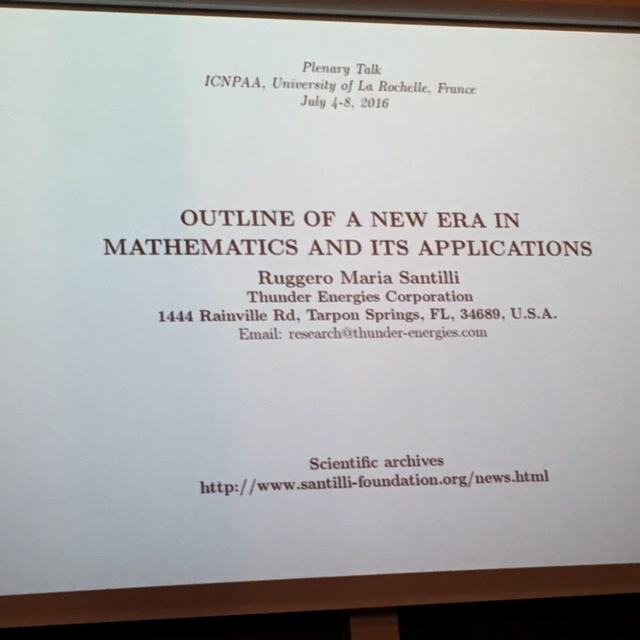
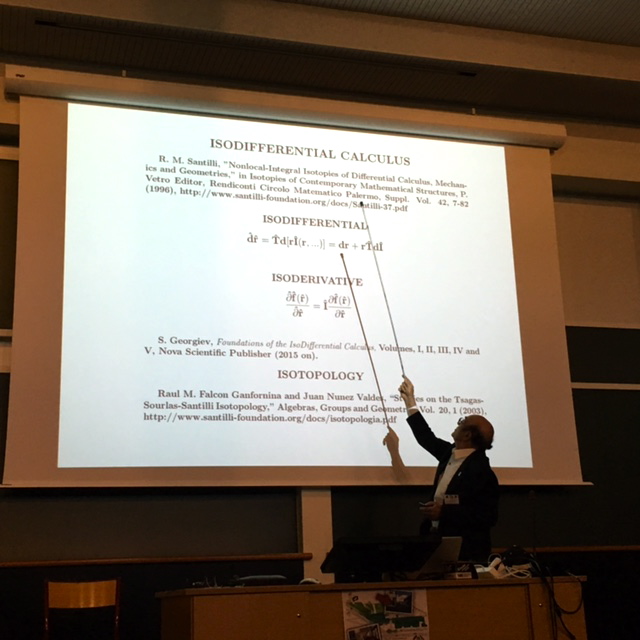
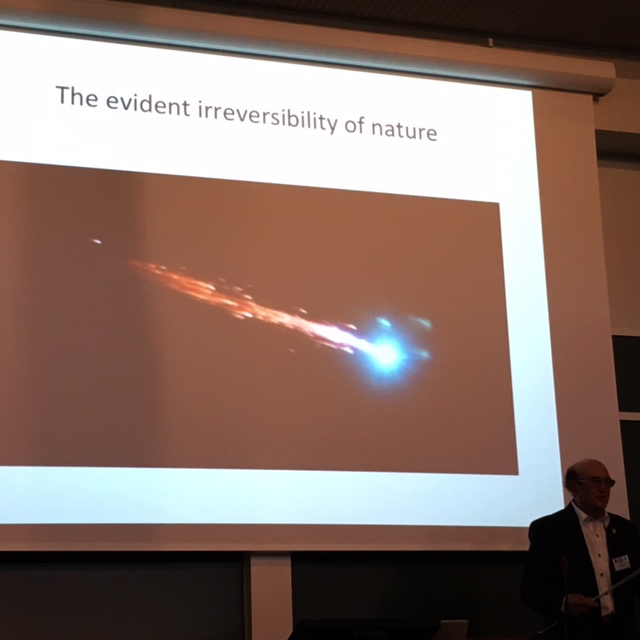
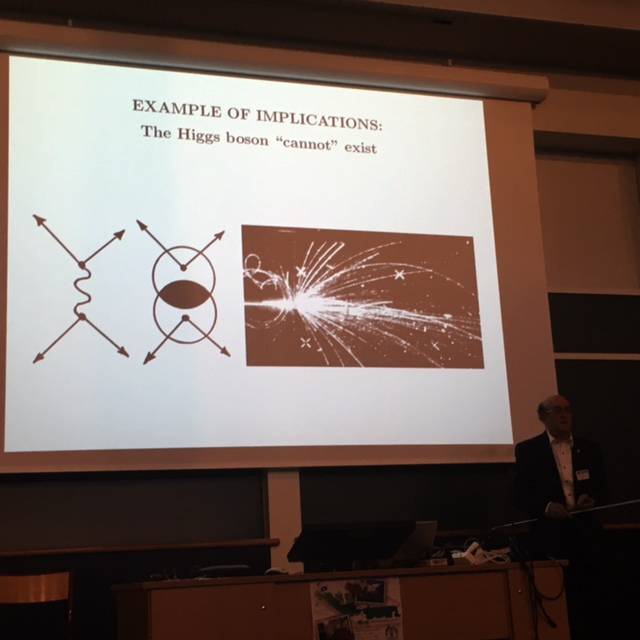
Images of Prof. Santilli's keynote talk at the Universite' de la La Rochelle from top left: talk title; presentation of his discovery of isomathematics and isodifferential calculus; presentation of his genomathematics for irreversible systems; presentation of structural advances in particle physics.
============================================
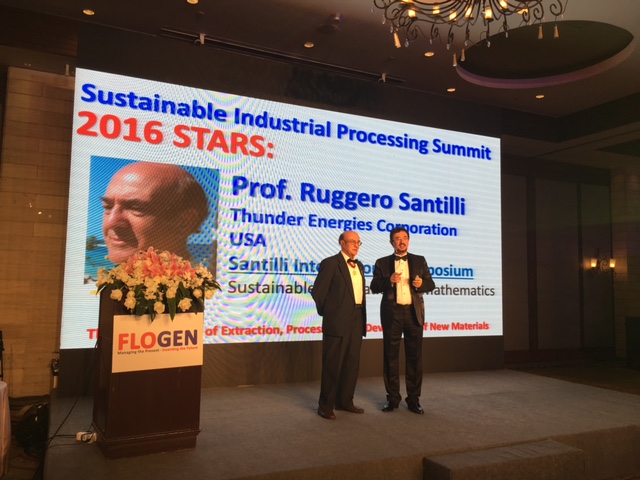
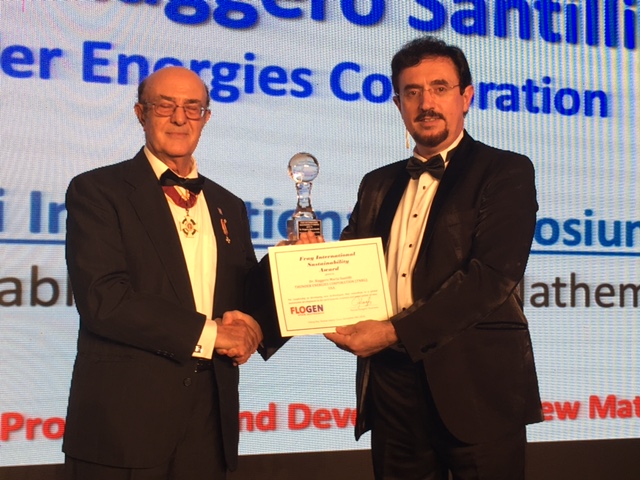
during the
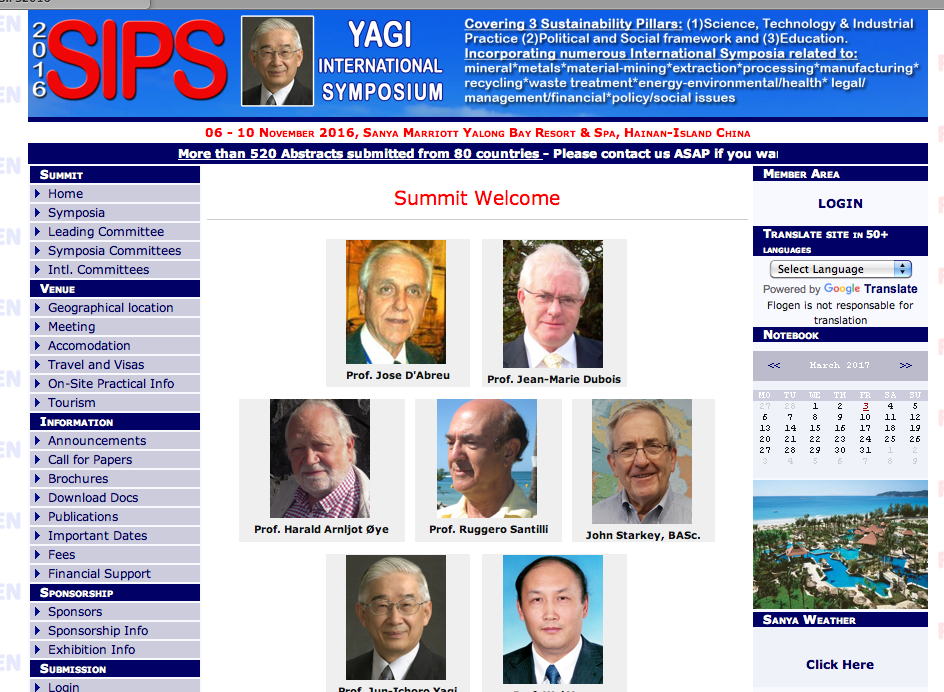
2016 - Sustainable Industrial Processing Summit & Exhibition
Hainan Island, China, November 6 to 10, 2016
http://www.flogen.org/sips2016/
========================================
PROF. RUGGERO MARIA SANTILLI KNIGHTED BY SERGIO MATTARELLA
PRESIDENT OF ITALY, WITH THE "ORDER OF THE STAR OF ITALY"
WITH THE TITLE OF SIR
at a ceremony organized by the Italian Consulate, Coral Gables, Florida, on May 31, 2018 in the occasion of Italy National Day.
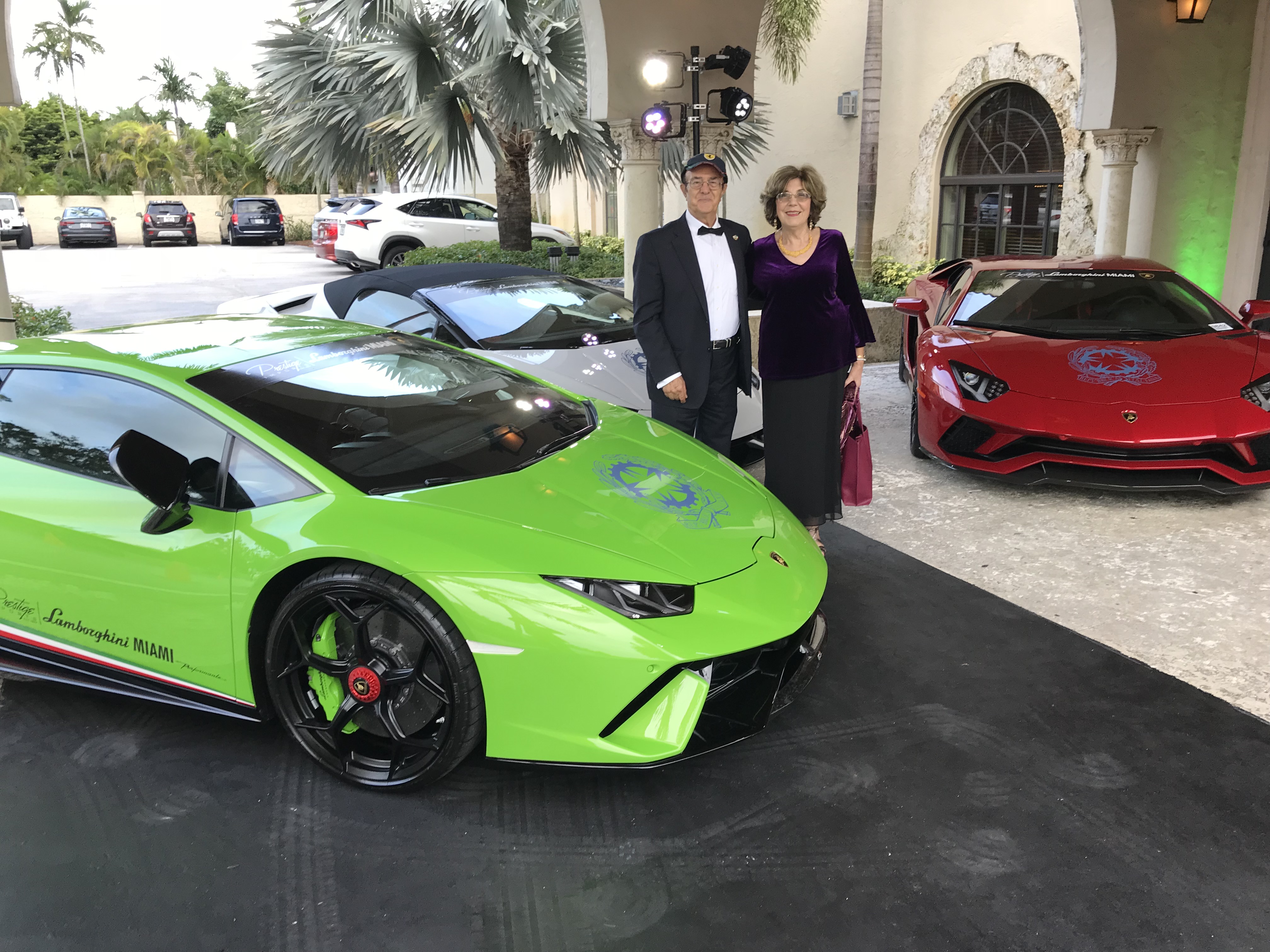
Prof. and Mrs. Santilli on arrival at the ceremony greeted by Lamborghini cars.
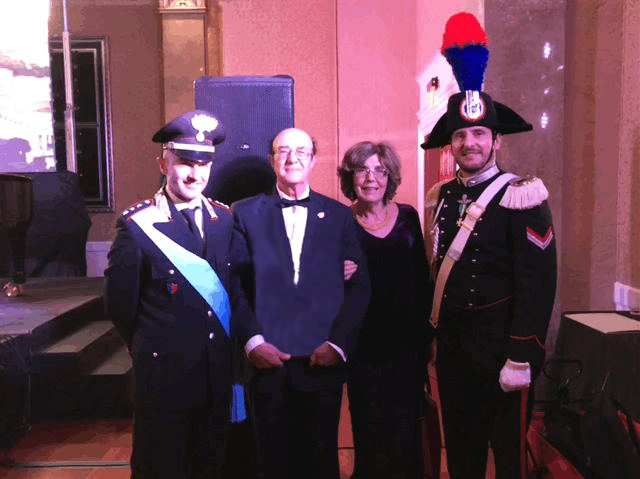
Prof. and Mrs. Santilli greeted on arrival by two Italian Carabinieri
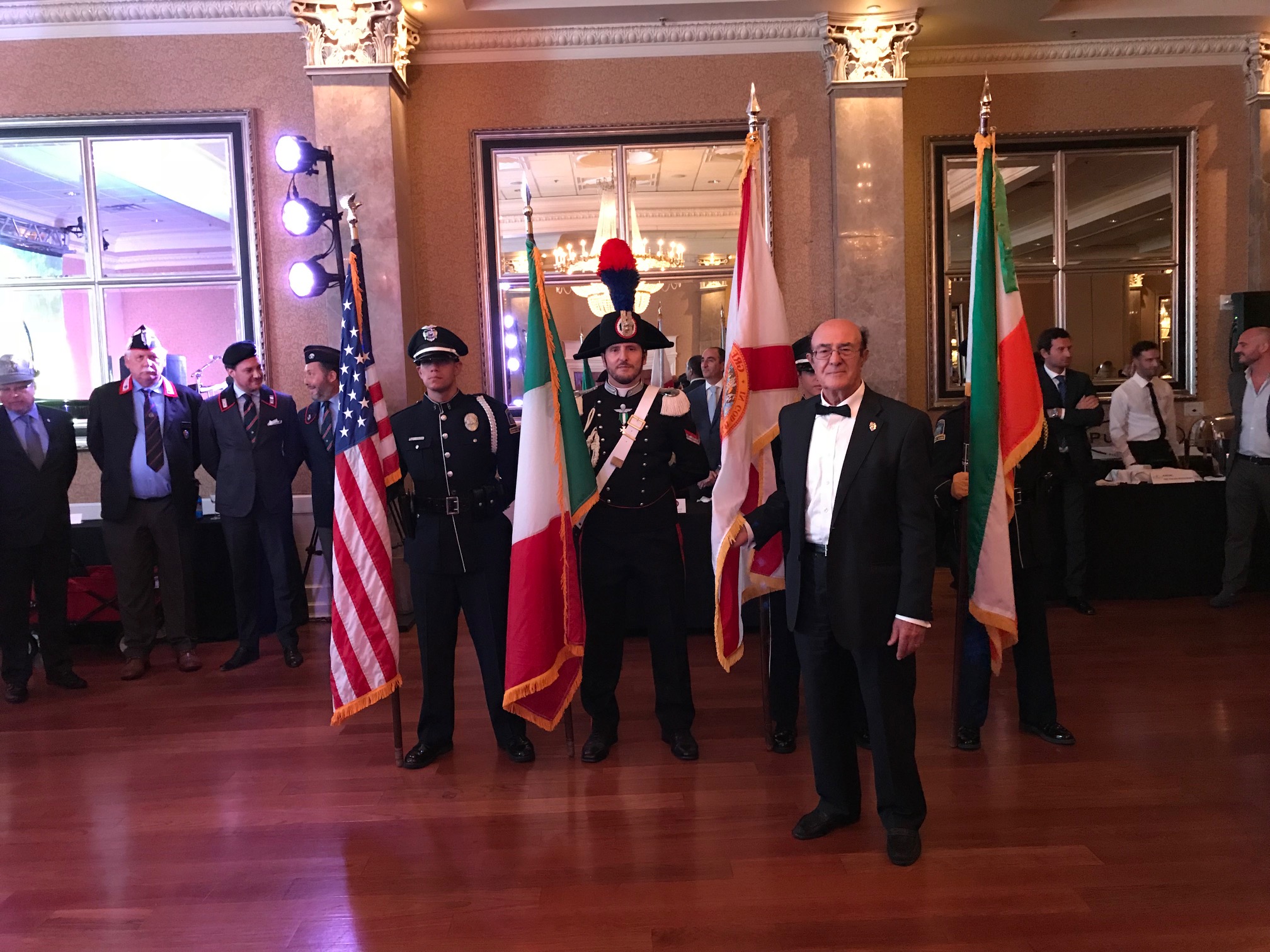
Prof. Santilli greets the Italian-American Guard of Honor
or
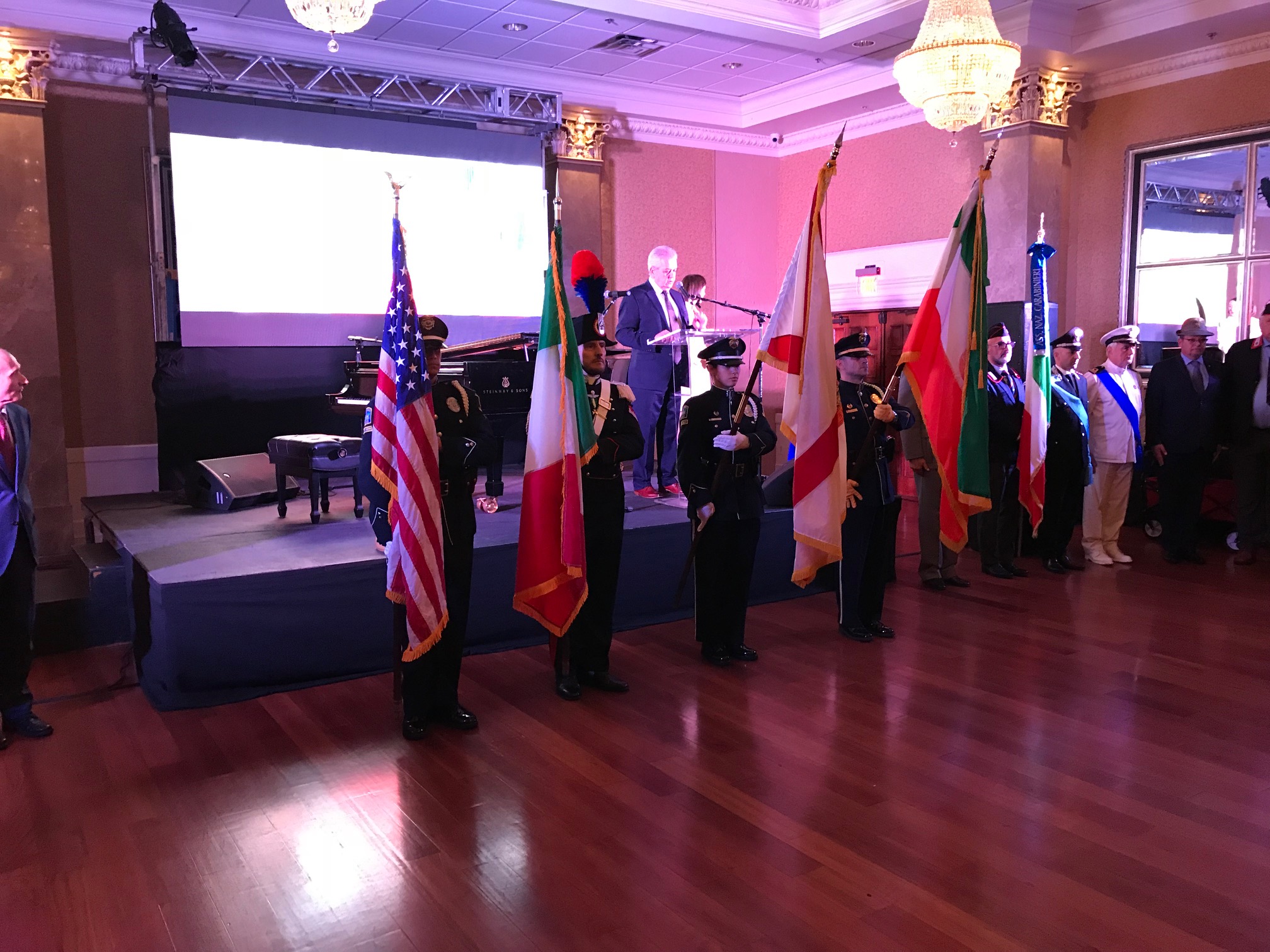
The Head of the Ceremony, Dott. Roberto Tagliero of the Florida Italian Consulate, declares the initiation of the ceremony
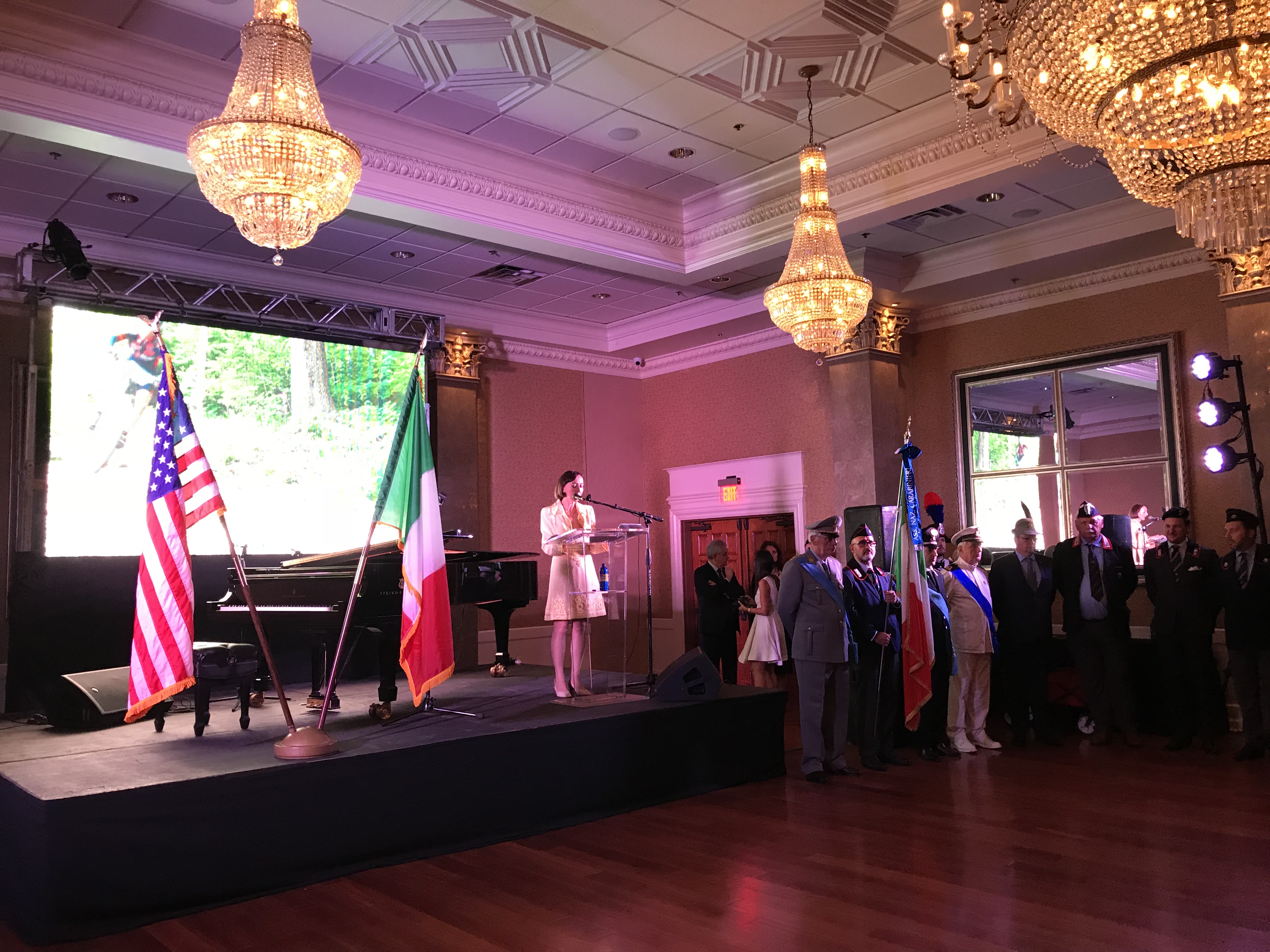
The Italian Consul General Dott. Gloria Marina Bellelli calls Prof. Santilli to the podium.
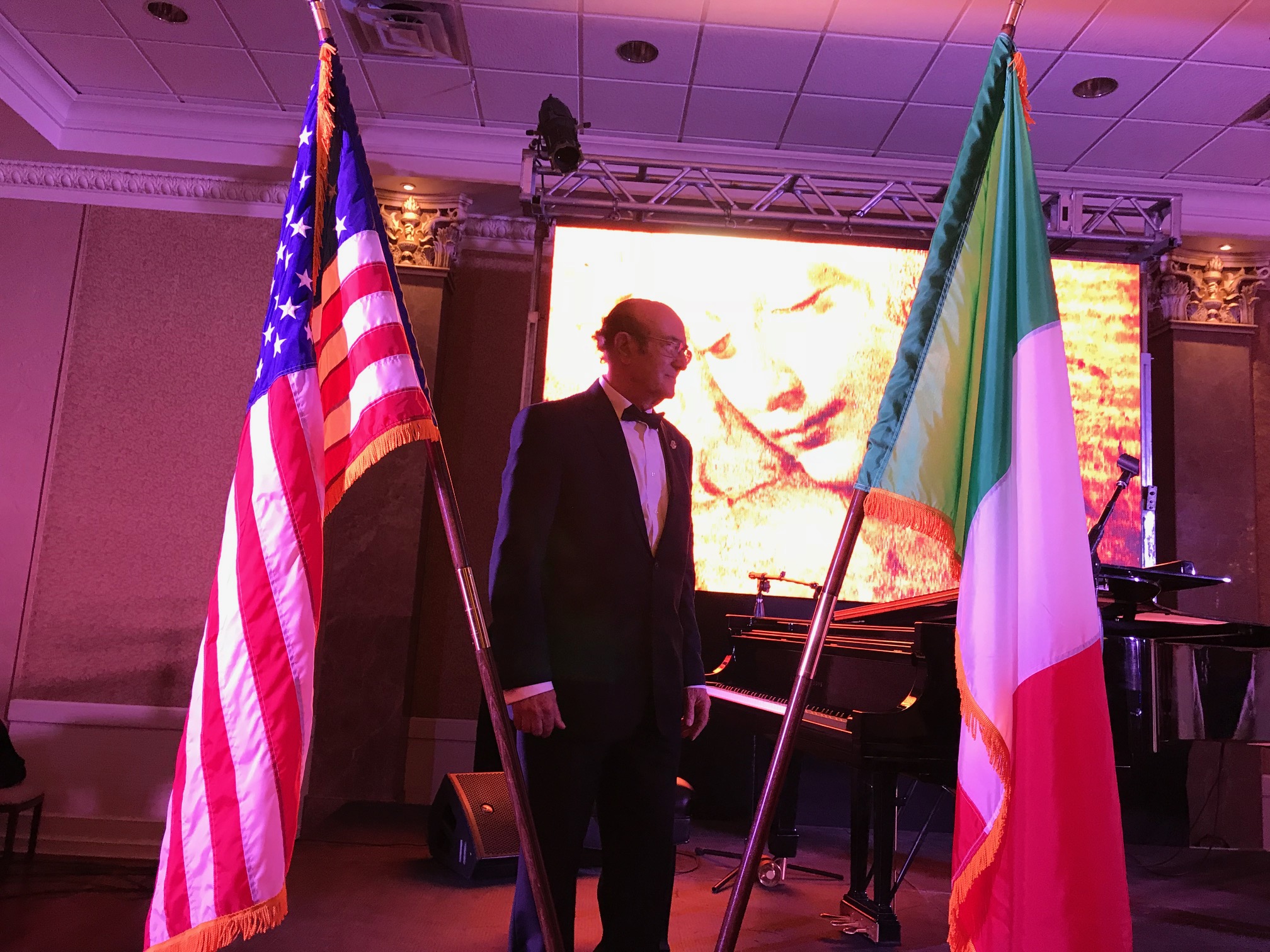
Prof. Santilli arrives at the podium passing in between the American and the Italian flags.
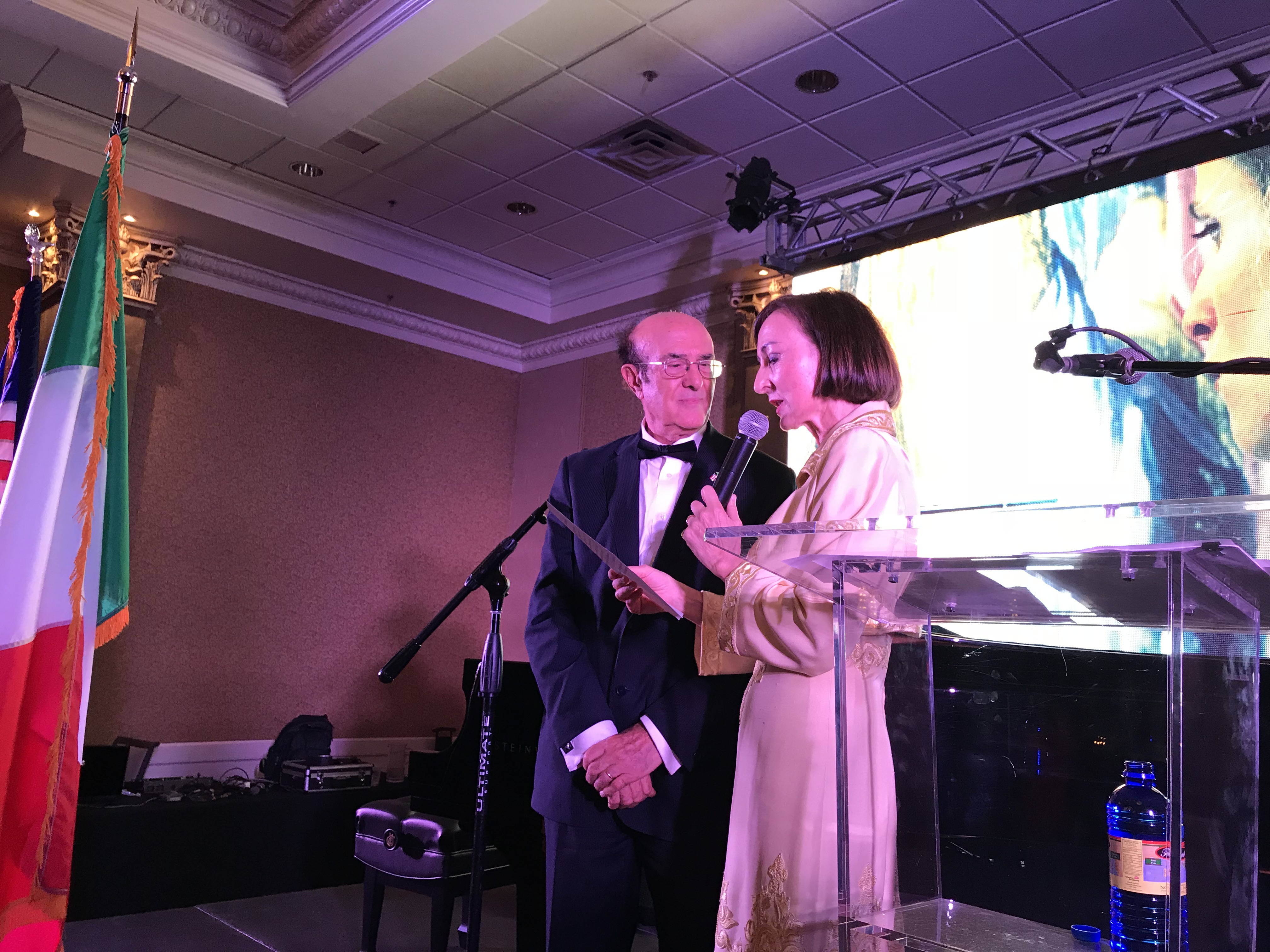
The Italian Consul General reads to Prof. Santilli the motivation for the honor by Sergio Mattarella, President of Italy:
"In carrying out his scientific and business activities , Professor Santilli is constantly engaged in the promotion of international collaborations involving Italian researchers and industries. Much of his research also focuses on the creation of technologies for sustainable development, aimed at improving energy efficiency and reducing pollution on a global scale. All this makes Ruggero Maria Santilli deserving of the title of Knight of the Order of the Star of Italy.
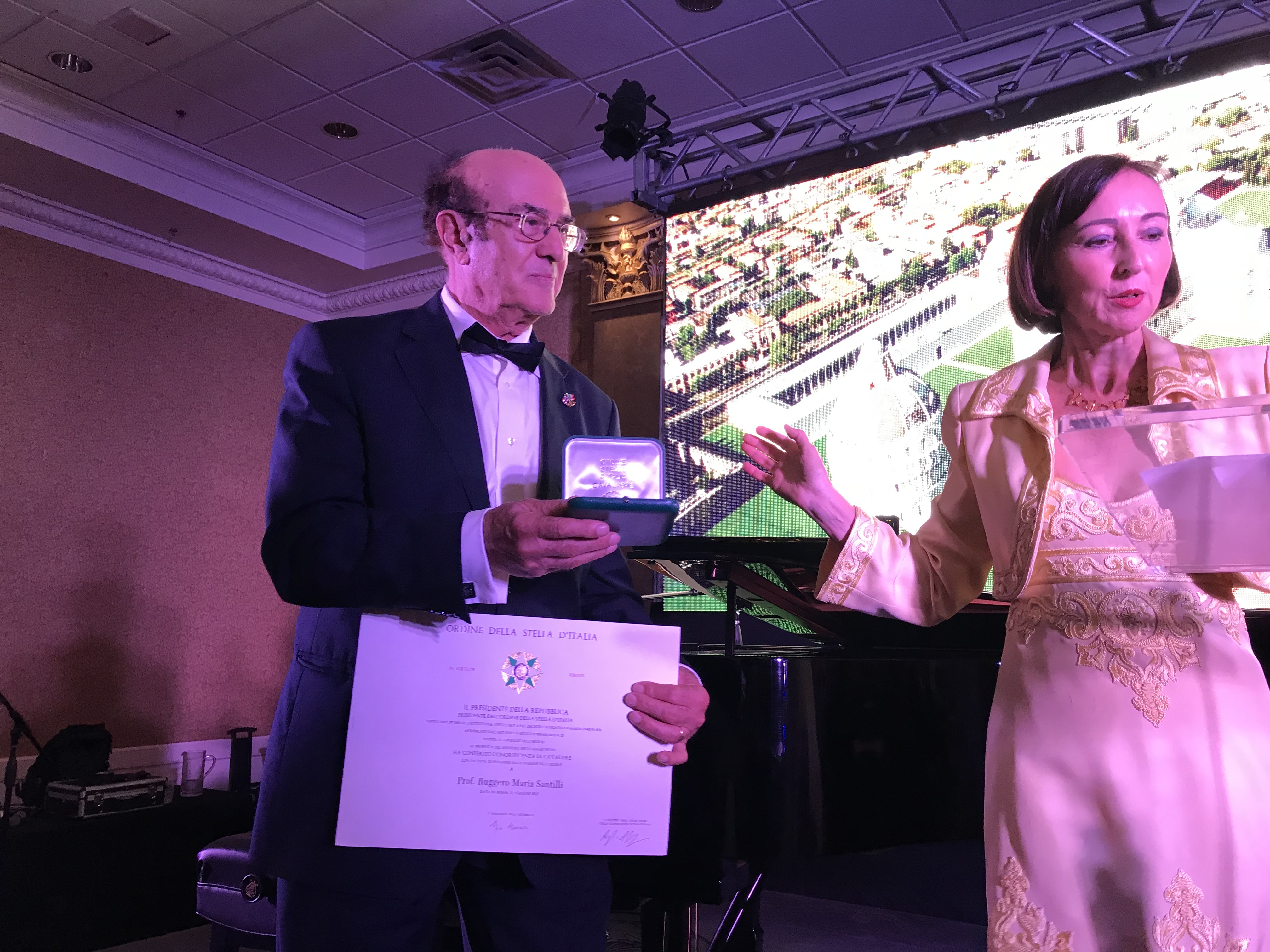
Prof. Santilli received the Star of Italy and the Motivation signed by Italy President Sergio Mattarella and co-signed by the Italian Minister for Foreign Affairs Dott. Angelino Alfano
The applause by invited guests
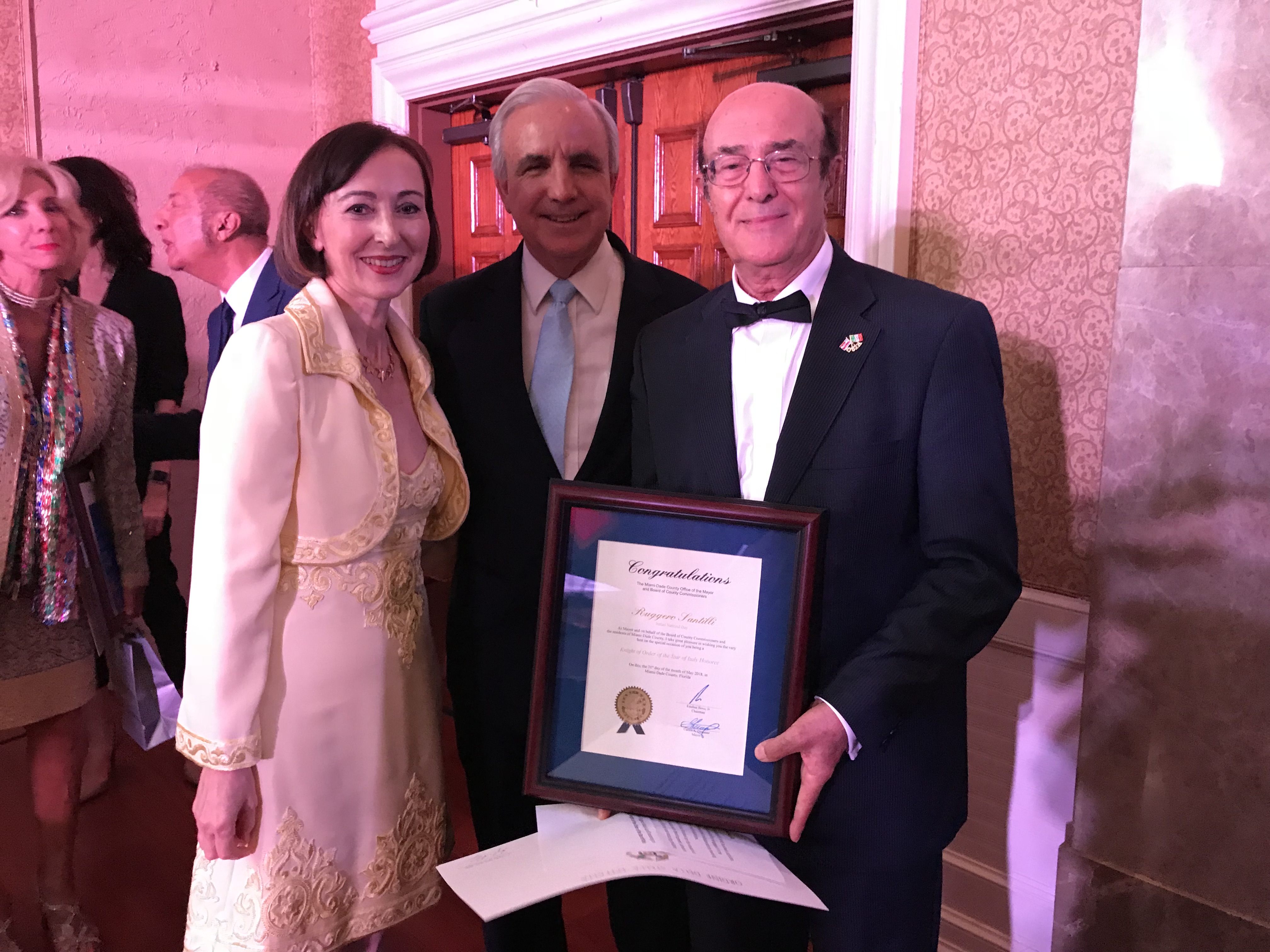
Prof. Santilli received from Miami Mayor Carlos A. Gimenez a Certificate of Congratulations for
"being a Knight of Order of the Star of Italy"
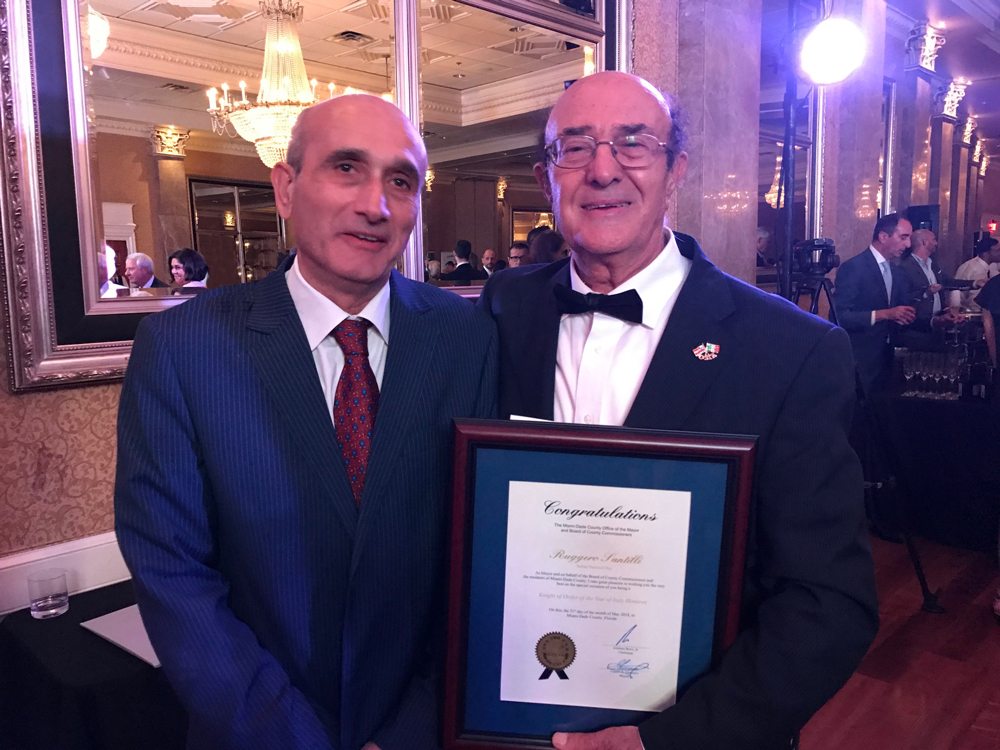
Prof. Santilli is congratulated by the Italian Vice Consul Dott. Lucio Taglione
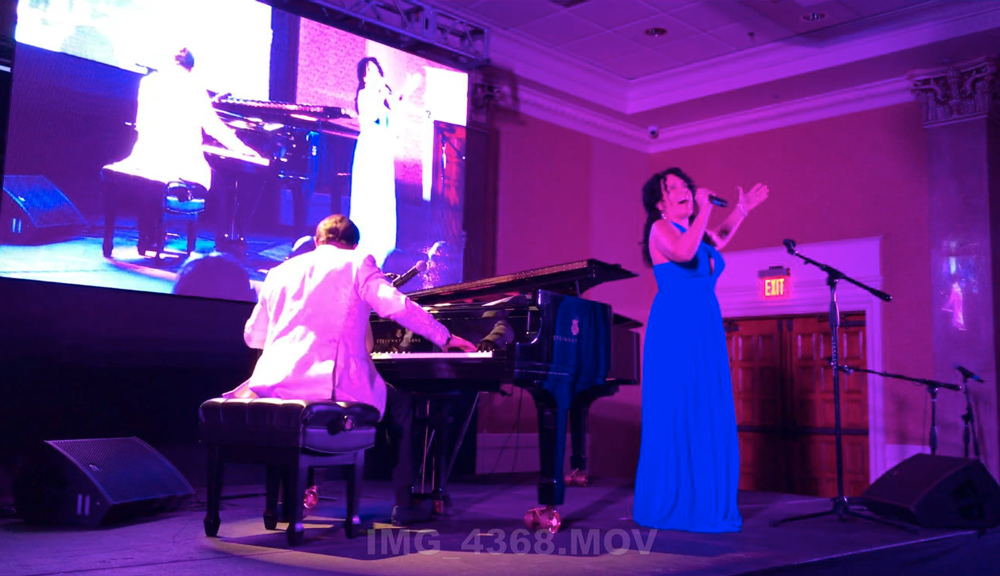
A view of the concert at the ceremony
A glimpse of the concert at the ceremony by the Pianist Di Blasio
============================================
============================================
NOMINATIONS FOR THE
NOBEL PRIZES IN PHYSICS AND CHEMISTRY
FOREWORD
To the Foundation's best knowledge, during the three decades following the inception of hadronic mechanics in 1978, Prof. Ruggero Maria Santilli has received hundreds of nominations for the Nobel Prize in Physics based on various motivations, such as (see the section on Scientific Discoveries for details):
1) Conception and development of the Lie-isotopic and Lie-admissible branches of hadronic mechanics as an axiom-preserving covering of quantum mechanics for the consistent quantitative study of conditions simply not treatable by quantum mechanics;
2) The discovery of the Lie-isotopic and Lie-admissible coverings of Galilean and special relativities for the dynamics of extended particles and electromagnetic waves propagating within physical media, while admitting conventional relativities as a particular case when motion returns to be in vacuum;
3) The discovery of the only known consistent classical theory of antimatter via his isodual mathematics that is compatible at the operator level with charge conjugation, with far reaching implications, such as the first possibility in scientific records to ascertain whether a far away galaxy is composed of matter or of antimatter;
4) The discovery of the only known axiomatically consistent operator formulation of gravity via the use of his isomathematics permitting the preservation of the Einstein-Hilbert field equations, while avoiding curvature as a necessary condition for consistency, and embedding gravity in the generalized unit of relativistic hadronic mechanics;
5) The achievement of the only known axiomatically consistent grand unification of electroweak and gravitational interactions inclusive of antimatter thanks to a geometric unification of special and general relativity permitted by his iso- Minkowski geometry;
6) The achievement of the only known exact, numerical representation of all characteristics of neutrons in their synthesis from protons and electrons via the use of the covering hadronic mechanics, a synthesis simply beyond any representational capability of quantum mechanics, as well as the experimental verification of said neutron synthesis via a arc within a hydrogen gas;
7) The discovery of the novel intermediate controlled nuclear fusion and its experimental verification; that has recently seen large industrial investments;
and other discoveries, each of which is evidently worth a Nobel Prize in Physics, particularly when compared to motivations of past and recent Nobel Prizes in the field.
All nominations were initially very confidential until recently. Due to known podiscoverieslitical shadows at the Nobel Foundation for granting Nobel prizes in physics to fully deserving recipients, yet on grounds of quark, neutrino and other hypothetical conjectures far from being truly verified on serious scientific grounds, with consequential predictable risk of scientific obscurantism, more recent nominations of Prof. Santilli have been intentionally made public, and available as free downloads from the web, so as to provide grounds for appraisals of the condition of contemporary physics by future historians.
Prof. Santilli has additionally received various nominations for the Nobel Prize in Chemistry beginning to our knowledge, in 1990, because of the following discoveries (see the section on Scientific Discoveries for details):
I) The only known quantitative formulation of chemical valence bond providing an actual force between identical valence electron pairs that is attractive, as well as permitting an exact representation of molecular binding energies and other molecular data;
II) The discovery of the first structurally new chemical species following the discovery of molecules in the mid of the 19th century, today known as Santilli magnecules, whose bond is stable at atmospheric conditions, and originates from suitable electric and magnetic polarizations, rather than from valence bonds;
III) The discovery of a new species of "heavy hydrogen" composed of 99.8 % hydrogen, yet with a specific weight over six times that of conventional gaseous hydrogen, with very important environmental applications;
and other discoveries.
Due to the deplorable ethical condition of contemporary chemistry, essentially imposing theories via academic power without a serious inspections of their limitations and their broadenings, most of Prof. Santilli's nominations in chemistry have been mede public, again, to allow future historians an appraisal of contemporary chemistry, due to the potentially sinister implications for the resolution of the current alarming environmental problems.
Following the release of the web site in a preliminary and incomplete form, the Foundation has been approached by various nominees of Prof. Santilli for the Nobel Prize in Physics, some of which have authorized the release of their nam, others have authorized the release of their nomination while keeping their name confidential, and these instructions have been religiously implemented ion the page.
Additional nominations of Prof. Santilli for the Nobel Prize in Physics and Chemistry are expected. However, the Foundation shall generally abstain from their report in this page since the nominations on record are more than sufficiently diversified, motivated and documented to provide the desired grounds for study and comparison by future historians.
It should be indicated that we attempted to inform the Nobel Foundation of the societal need for new basic advances in physics since the alarming environmental problems afflicting our planet can only be resolved by surpassing Einsteinian doctrines and quantum mechanics. The attempt was done in March 18, 1998 via a very respectful open letter to Prof. Bengt Nagel, then Chairman of the Nobel Committee for Physics (letter available on request to
It should be indicated that Prof. Santilli felt obliged to write the above "open" letter because he "saw" Prof. Nagel at the Sanibel Symposium in St. Augustine, Florida, one month earlier and approached him by asking for the courtesy of discussing the axiom-preserving isotopies of quantum mechanics, but Prof. Nagel left without even acknowledging Prof. Santilli's respectful greetings, due to apparent fear of contamination by the very exposure to novelty.
The above regrettable episode and numerous others quite damaging to the reputation of the Nobel Foundation, explain the "open" character of some (but not all) recent nominations for the Nobel Prize in Physics and Chemistry when motivated by truly "novel" discoveries, that is, discoveries that, by definition, surpass Einsteinian doctrines and quantum mechanics.
Following the release of the web site in a preliminary and incomplete form, the Foundation has been approached by various nominees of Prof. Santilli for the Nobel Prize in Physics, some of which have authorized the release of their name, others have authorized the release of their nomination while keeping their name confidential, and these instructions have been religiously implemented in this page.
SAMPLES OF NOMINATIONS FOR THE NOBEL PRIZE IN PHYSICS
The first nomination of Prof. Santilli for the Nobel Prize in Physics was filed in 1985 by Prof. A. O. E. Animalu as visiting scholar at the Massachusetts Institute of Technology. This nomination was subsequently followed by various nominations from around the world. The "International Committee for the Nobel Prize Nomination of Prof. R. M. Santilli" was organized in 1987 to coordinate the nominations under various chairman.
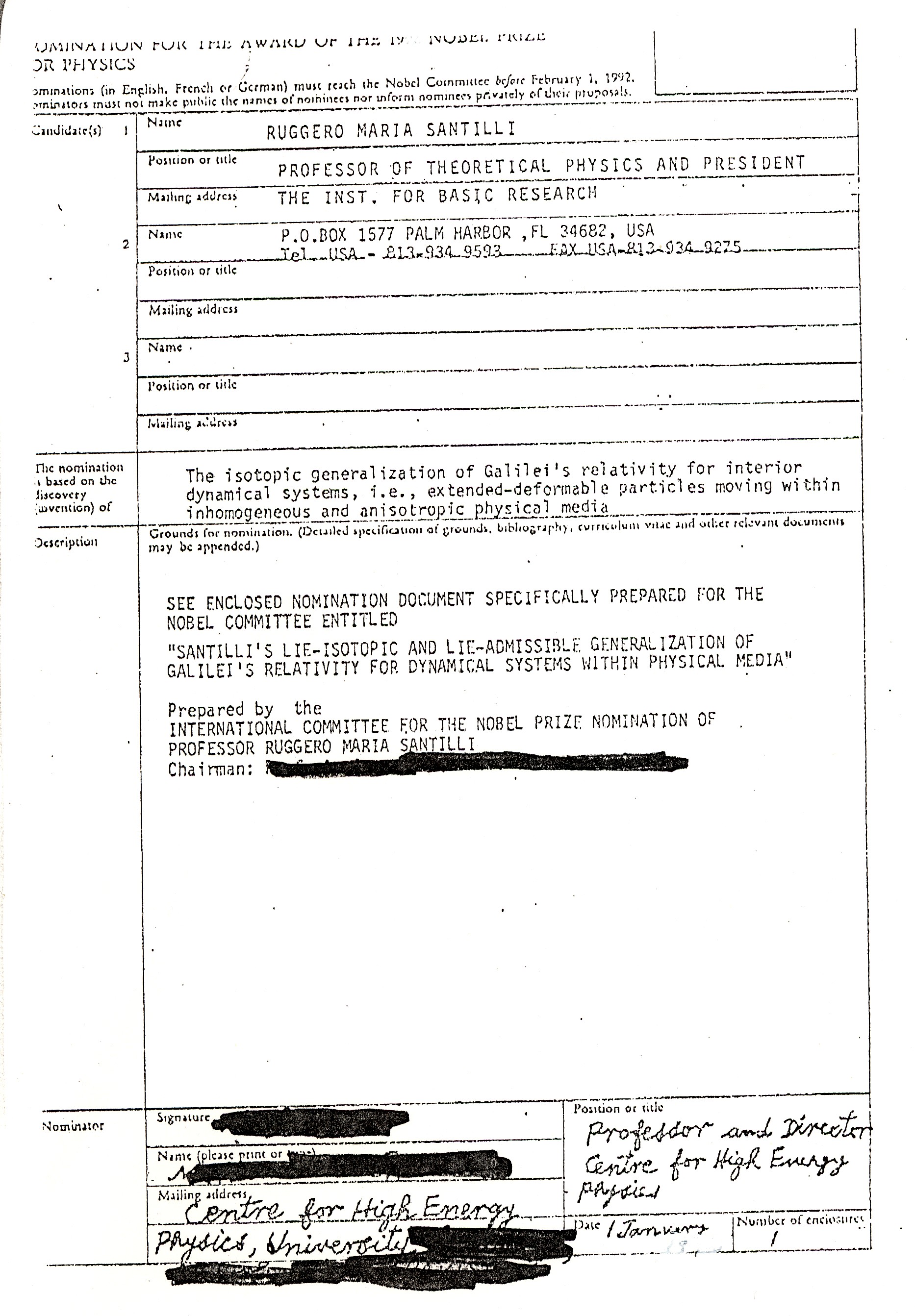
An early nomination by "Professor and Director" of a "Center for Theoretical Physics" in the official form of the Nobel Foundation who requested to remain anonymous.
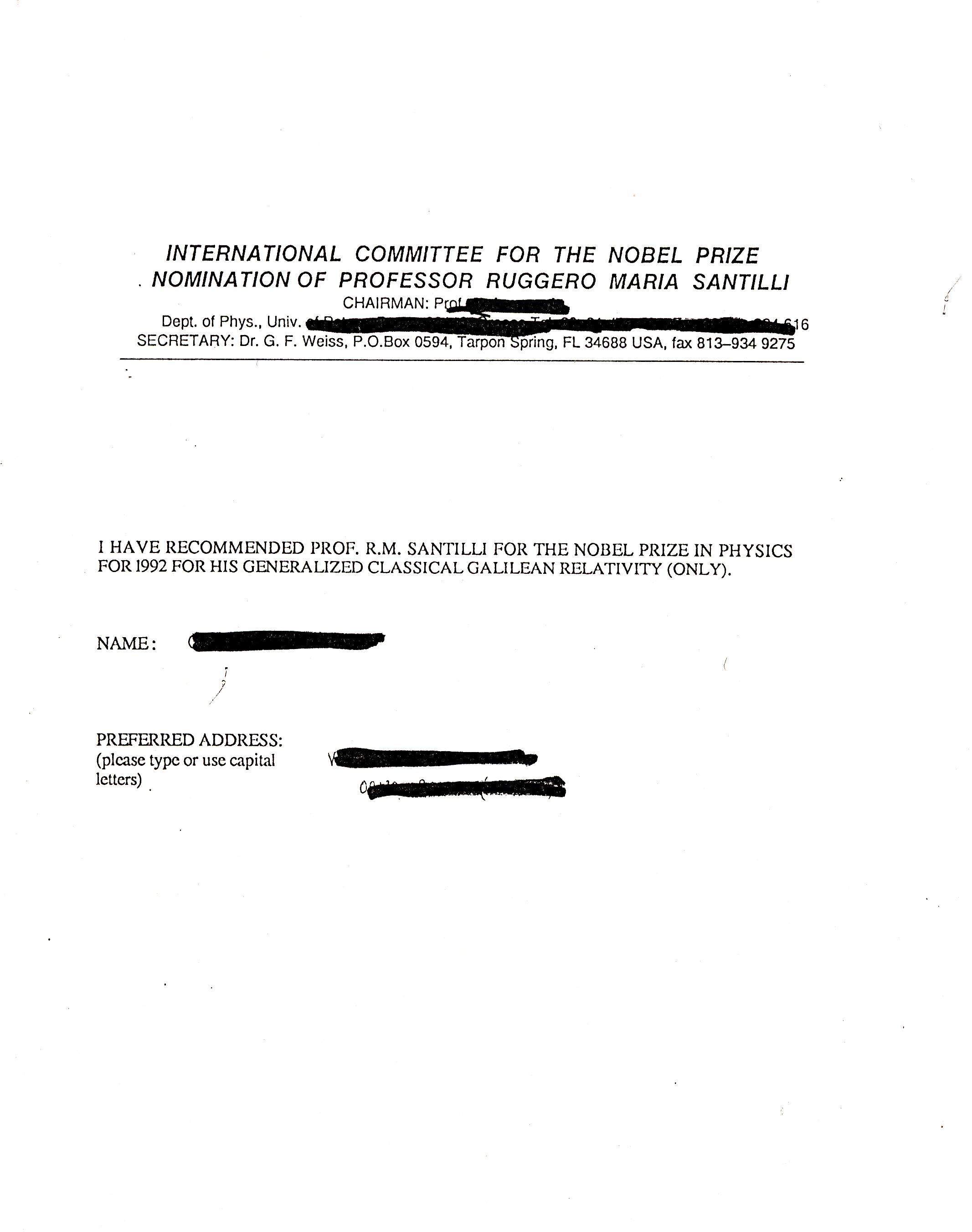
TA nomination by a member of the "International Committee for the Nobel Prize Nomination of Prof. Ruggero Maria Santilli" who requested to remain anonymous.
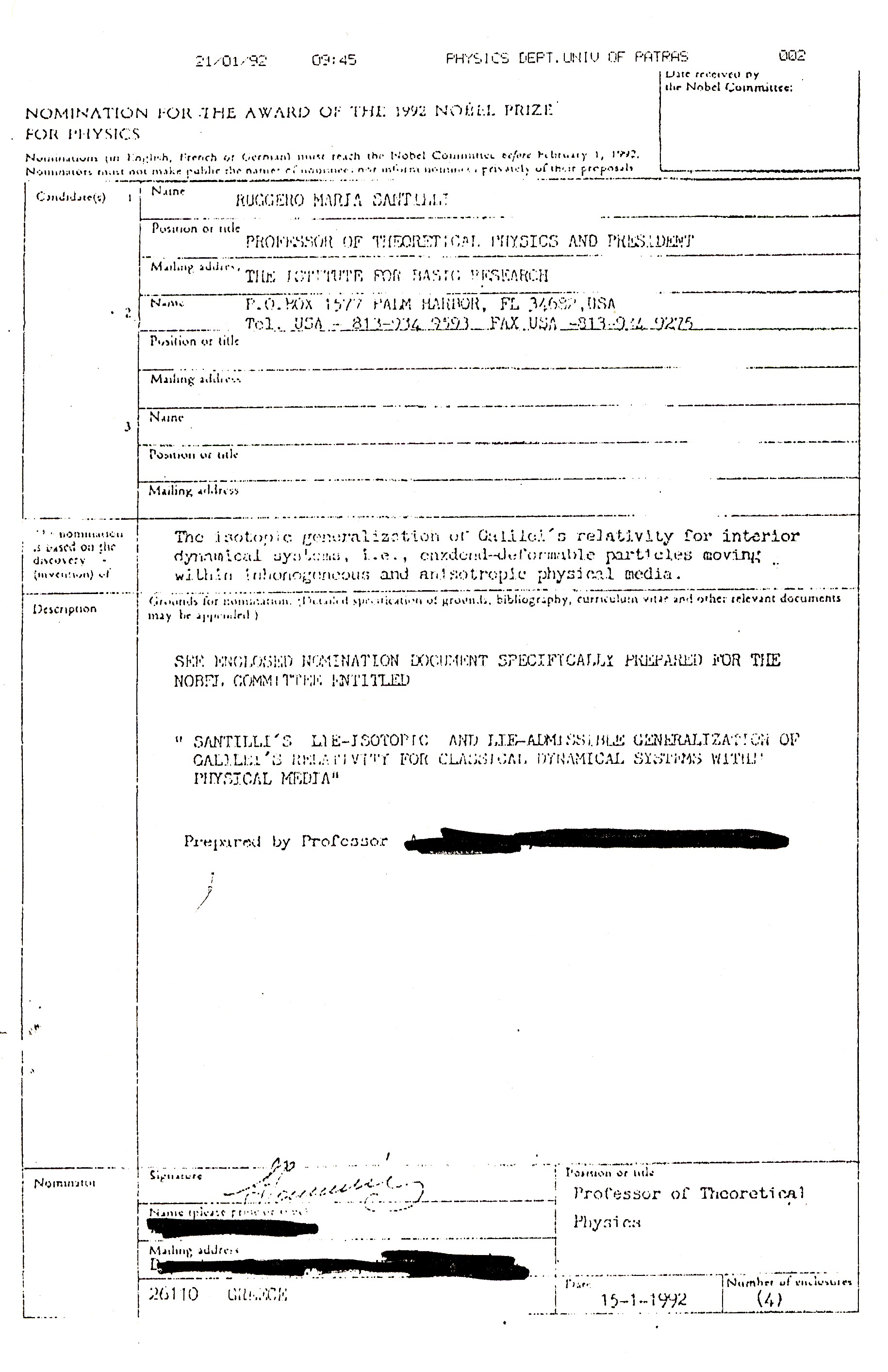
Another early nomination from a "Professor of Theoretical Physics" who requested to remain anonymous.
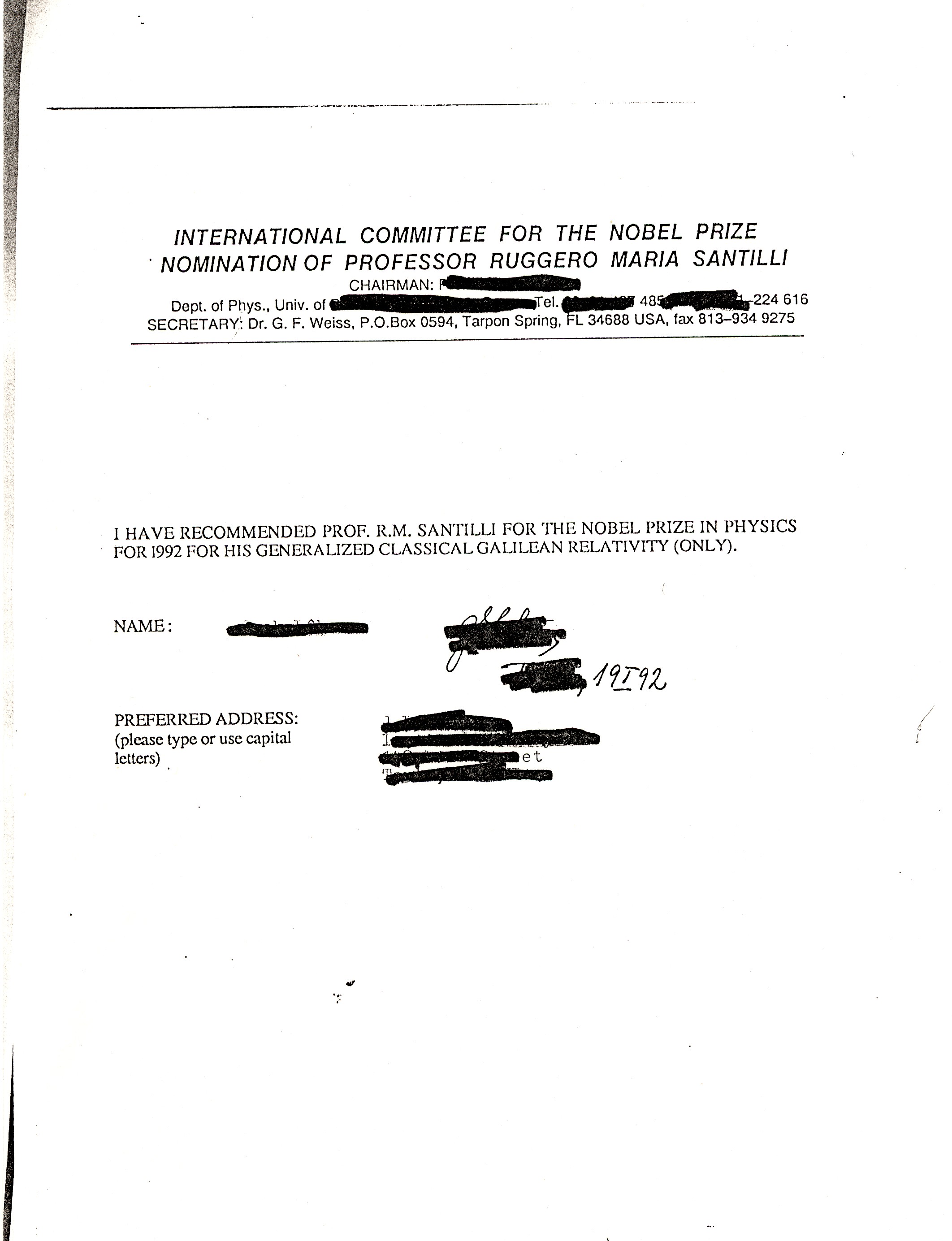
Another nomination by a member of the "International Committee for the Nobel Prize Nomination of Prof. Ruggero Maria Santilli" who requested to remain anonymous.
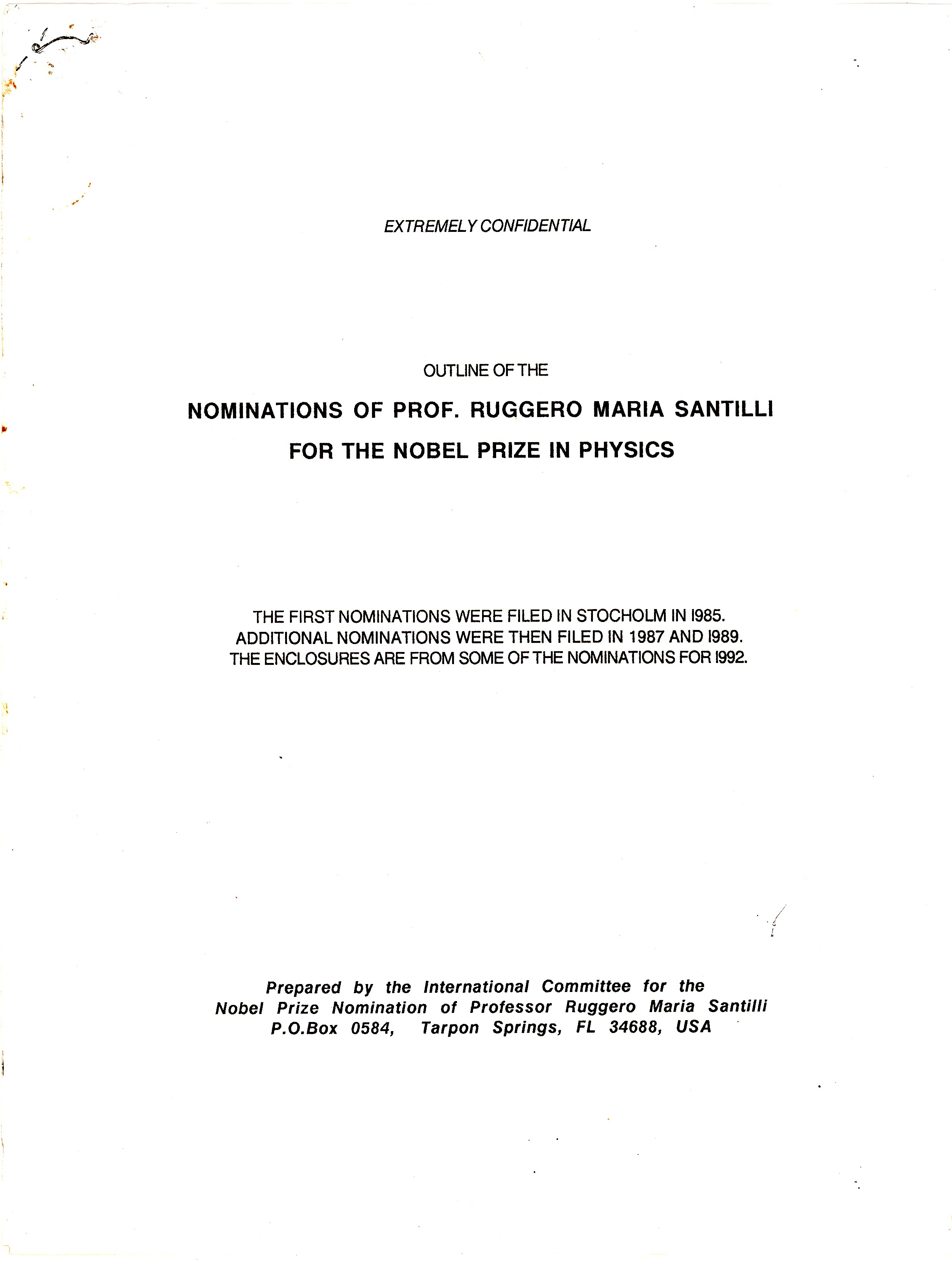
A summary of nominations from 1985 to 1992 presented to the Nobel Committee for Physics by "International Committee for the Nobel Prize Nomination of Prof. Ruggero Maria Santilli".
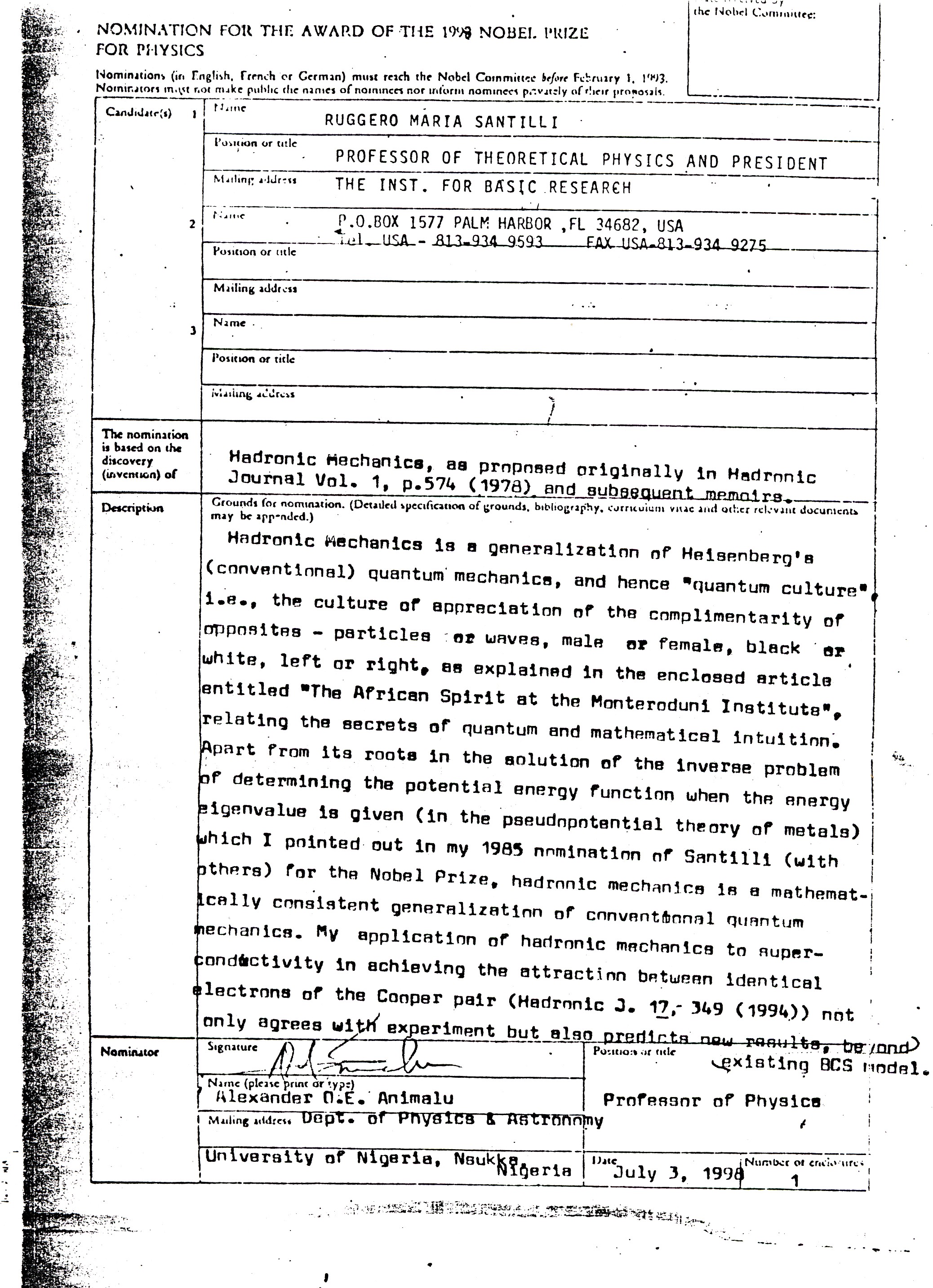
Example of a nomination of Prof. Santilli for the 1998 Nobel Prize in Physics on the official form received by the nominee.
A detailed nomination of Prof. Santilli by a British scientist who wishes to remain anonymous
Nomination of prof. Santilli for the Nobel Prize in Physics
A nomination of Prof. Santilli by a U. S. professor of physics who wishes to remain anonymous
Nomination of prof. Santilli for the Nobel Prize in Physics
A 1992, comprehensive,, 100 pages long nomination of Prof. Santilli by A. Jannussis, Professor of Physics at the University of Patras, Greece
Nomination of prof. Santilli for the Nobel Prize in Physics
A 1998 detailed nomination by a member of "International Committee for the Nobel Prize Nomination of Prof. Ruggero Maria Santilli" who wishes to remain anonymous
Nomination of prof. Santilli for the Nobel Prize in Physics
A 1998 inspiring nomination by the American-German scientist H. E. Wilhelm
Nomination of prof. Santilli for the Nobel Prize in Physics
A 2001 nomination by Prof. S. L. Kalla from the University of Kuwait, Kuwait
Nomination of prof. Santilli for the Nobel Prize in Physics
An important 2003 nomination by a known physicist from a known institution in Zurich, Switzerland
Nomination of prof. Santilli for the Nobel Prize in Physics
 Nomination of Prof. Ruggero Maria Santilli for the 2007 Nobel Prize in Physics
Nomination of Prof. Ruggero Maria Santilli for the 2008 Nobel Prize in Physics
First Open Nomination of Prof. Ruggero Maria Santilli for the 2012 Nobel Prize in Physics
Second Open Nomination of Prof. Ruggero Maria Santilli for the 2012 Nobel Prize in Physics
Third Open Nomination of Prof. Ruggero Maria Santilli for the 2012 Nobel Prize in Physics
2016 Open Nomination of Prof. R. M. Santilli for the Nobel Prize in Chemistry
SAMPLES OF NOMINATIONS FOR THE NOBEL PRIZE IN CHEMISTRY
Nomination of Prof. Ruggero Maria Santilli for the 2007 Nobel Prize in Chemistry
Nomination of Prof. Ruggero Maria Santilli for the 2008 Nobel Prize in Chemistry
2016 Open Nomination of Prof. R. M. Santilli for the Nobel Prize in Chemistry I
2016 Open Nomination of Prof. R. M. Santilli for the Nobel Prize in Chemistry, II
Email: board(at)santilli-foundation(dot)org